Such an Air (VI)
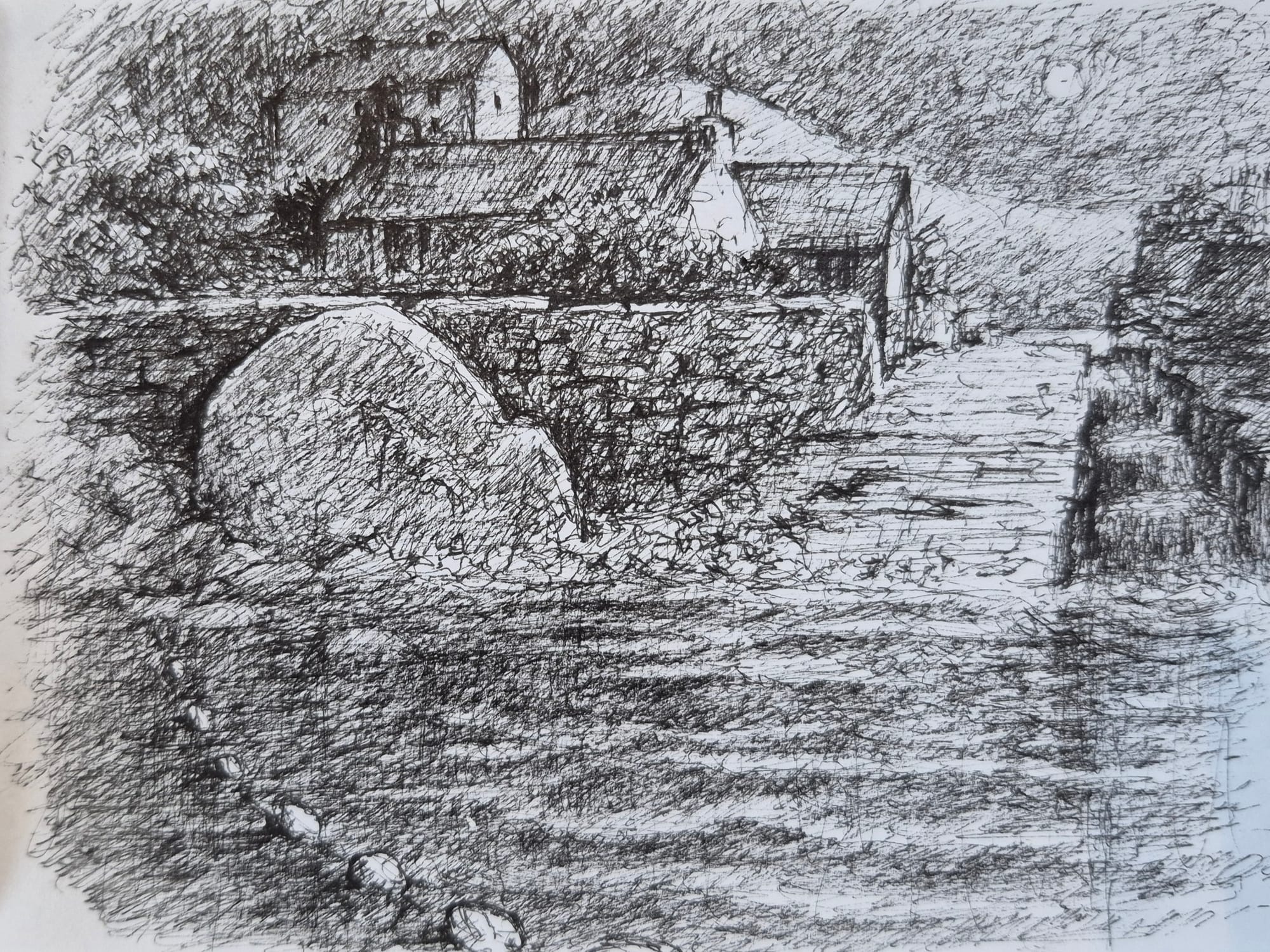
SO.—JOCK? GIRLIE? The boys at the quarry? His own Arcadians. There were plenty of stories, and things he felt towards: nets, boats, lapsters, moons, creels, cuithes. Seaboots. Folk “not disquieted by the desire for change,” as Pater has it. Well, almost.
What had Girlie called her niece, named after her? Alice Mary. Peedie Alice Mary... Peedie Mary. Peedie Gill—Peedie Janet? No: too Bigsy Sarah Lawrence, but no, not really, he could forgive her, and a lovely dancer—Peedie Sigurd? Siggie? Peedie Lapster? Peedie Thibault? Peedie Gerald de Nerval? Peedie Shug? Peedie Mansie? All these cousins that cannot. Cannot what? Dance? Marry? Swim? Kiss? Cannot kiss?
It was just a pity he couldn’t stay here and still get the Assistance. In Edinburgh he’d scanned the Orkney papers and dreamed of a couple of acres where he could set himself up as a crofter (by day), and get himself a peedie yole. A place on Wyre (in Wyre?) he’d heard of. Jock would know someone who could plough for him, and keep him right. He was little more than a peasant himself, after all, despite the state of his hands, still clarted by the fields of Dunira.
Perhaps he could sell another play, or even write one, somehow. Out of what?
SCENE 1
(Midnight, moonless. The tide has turned. A rasp of seaboots, and a sigh.)
Oh Jeemsie…
(A gust of wind. A splashing on a bow, newly-painted. A yole shifts. The tide has turned.)
SCENE 2
Etc.
But then there’s the Tax, and then there’s Marion, so much the pitiable wronged wife now, after scorning the idea for years. Terrible, aye. He could hardly pretend in that sense to be making a new start, despite having brought so little, but really he'd have to make a space for himself in the ways that mattered.
He’d long been attracted to the north, to Northern European and Russian literature and art, with a coherence and vitality he felt were absent from present day Scotland, describing himself in his book as “a Symbolist in—roughly—the tradition of Sologub”. In tackety boots. And sticking plasters. Working towards small, beautiful effects of language.
It was what he could remember feeling here that when he suddenly found himself homeless, when Marion had thrown him out, that had immediately made him desperate to return. Somewhere he knew and could restore himself. Not in the city, certainly, despite the years he'd spent there, and not any longer in Perthshire, hemmed in by hard-eyed factors and gamekeepers hammering on the door:
Drum na Keil, ye’ll be wantit fur thi beatin the morn!
That rancour and threat, no less than the pines and mountains, the rocky burns, the folk he met there—the feudal gowks and the miners and factorymen escaping to the hills—it had been out of those elements that his stories and plays had come. (Though not the mood indoors.) Last year hadn’t helped with anything, not even with Janet, un-divorced as he remained, though The Sea-Bed was something, and for his parents and his aunts to show around. Not that they ever complained.
Might he too have gone to the States? Sydney Graham had suggested it years ago. Now salted away in Cornwall. Only he regretted his shed, leaky as it was, up there on the hillside, and its old shepherds’ table.
It would have to be in Scotland, or here. Was this Scotland? Girlie said yes, but Ernest demurred, referring to Margaret of Norway and the 14-hundred and something pawning of the islands, and the Scots Earls.
But here he was anyway, at last, blistered but with something like his shed, that old empty house next door especially. Maybe he could set up a wee bed in there too. Its view of the Sound and the boats. Peace dropping slow. And the girls coming up. With a burn to fish in and the pool.
He lit the tilley lamp and raked the fire. Wound the gramophone. Dropped the new needle gently onto Bridie. Filled his pen.
Oh, tonight in fancy come and take a trip across the sea...
Began a—
An engine, then a scraping and a scuffle at the door, a moaning.
The sneck, the sneck rattling...
And we’ll meet our old companions in the place we long to be....
He stared.
For stamped upon our memory are the friends we used to know...
A face looked in, moon-pale in the shadows, but bearded, scruffy. From another world. Tall. An Irish boy he'd encountered once or twice in Edinburgh.
Was he dreaming again?
The figure groped forward, his face blotchy now in the lamplight. A rucksack fell to the floor. He slumped onto it, gathered himself. Jock behind him at the door.
So just tonight let's revel in the thoughts of long ago...
“Ian? It’s me, it's John. John Sharkey.
"It’s me, Ian, I’m not well at all.”
What, why...
Sweet suffering...
Notes
Thus concludes a narrative which very loosely concerns the early stages of the seminal second visit made to Orkney by the poet Ian H. Finlay (as he then was) in spring 1959. A coda follows.
The title is taken from Finlay’s poem, from The Dancers Inherit the Party (1960), “Mansie Considers Peedie Mary”. It mainly provides background for a publication entitled Rousay Mending: A Footnote, the subject of which, Rousay Mending, originally a centenary homage to IHF, is also published in Orkney by Brae Editions, 2026, and is illustrated below.
Such an Air is presented without notes, but it may be of interest that a Bibliography and Endnotes are available for the Footnote.
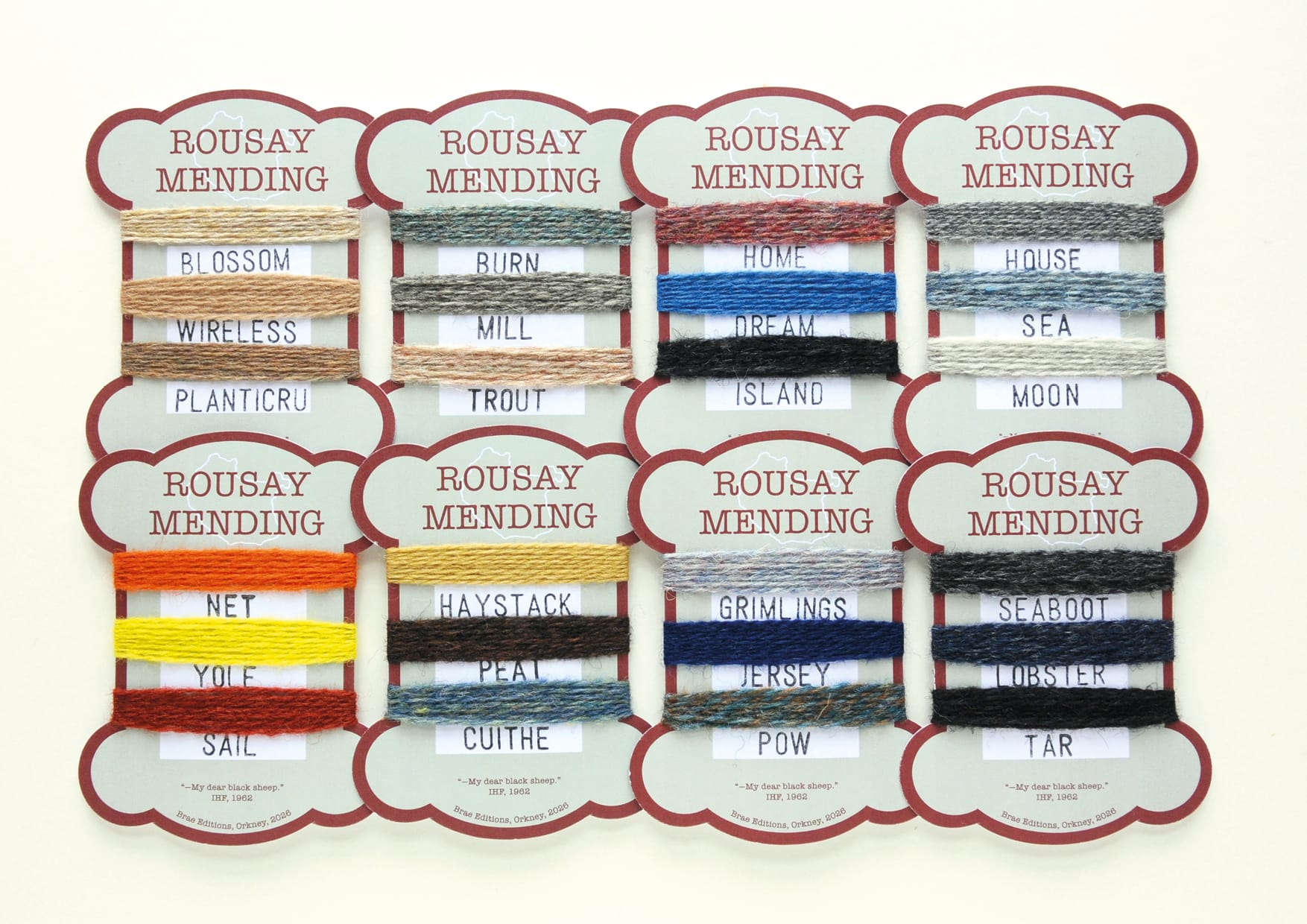
Such an Air is thus a speculative account of selected events, persons, and places that Finlay may have encountered in the early stages of that 1959 visit, the information having been derived from or been prompted by documentary sources, interviews and visits. The account borrows here and there from Finlay's work in ways which will largely be obvious, we hope, to his readers and admirers. But for the avoidance of doubt, we emphasise that a good deal of licence has been taken with what might have occurred during the period in question. Unlike Rousay Mending: A Footnote, Such an Air is not meant to be understood as factually accurate. It would hardly be true to say that no resemblance is intended to any person, alive or dead, but where it may be relevant to say so, no disrespect is intended to their memory. Further, no certainty is to be understood as having been assumed in representing how they thought about others, or how others may have thought about them.
The text above and those that follow will be revised from time to time and may be withdrawn without notice.
Alistair Peebles, Brae Editions, Orkney, 2026