Rousay Mending
Rousay Mending: 24 Island Words & Colours (with Selected Brews) for Ian Hamilton Finlay, by Alistair Peebles, is now available to purchase from two sources: the Pier Arts Centre, Stromness, Orkney (in person or online) and James Fergusson Books and Manuscripts, London.
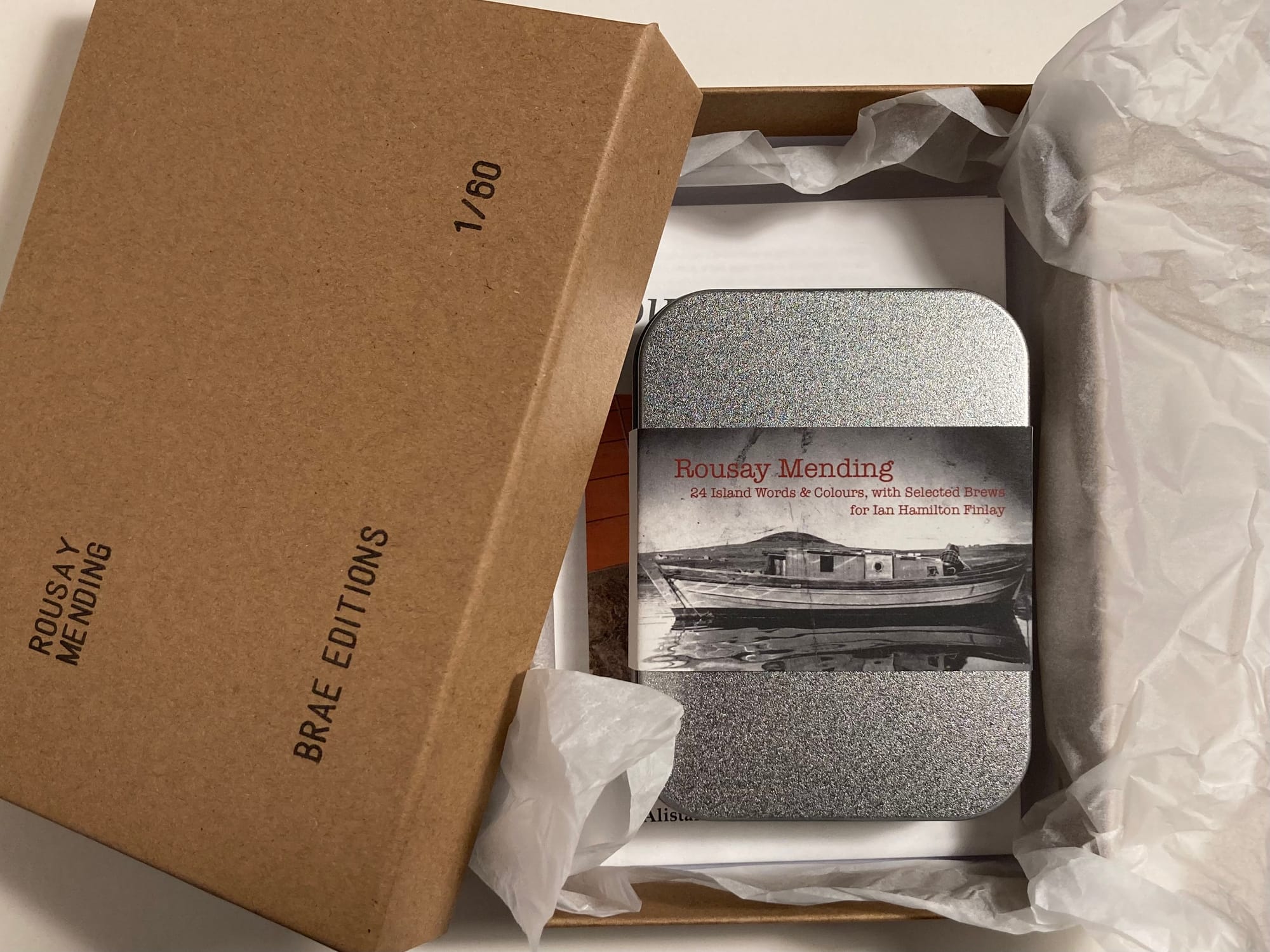
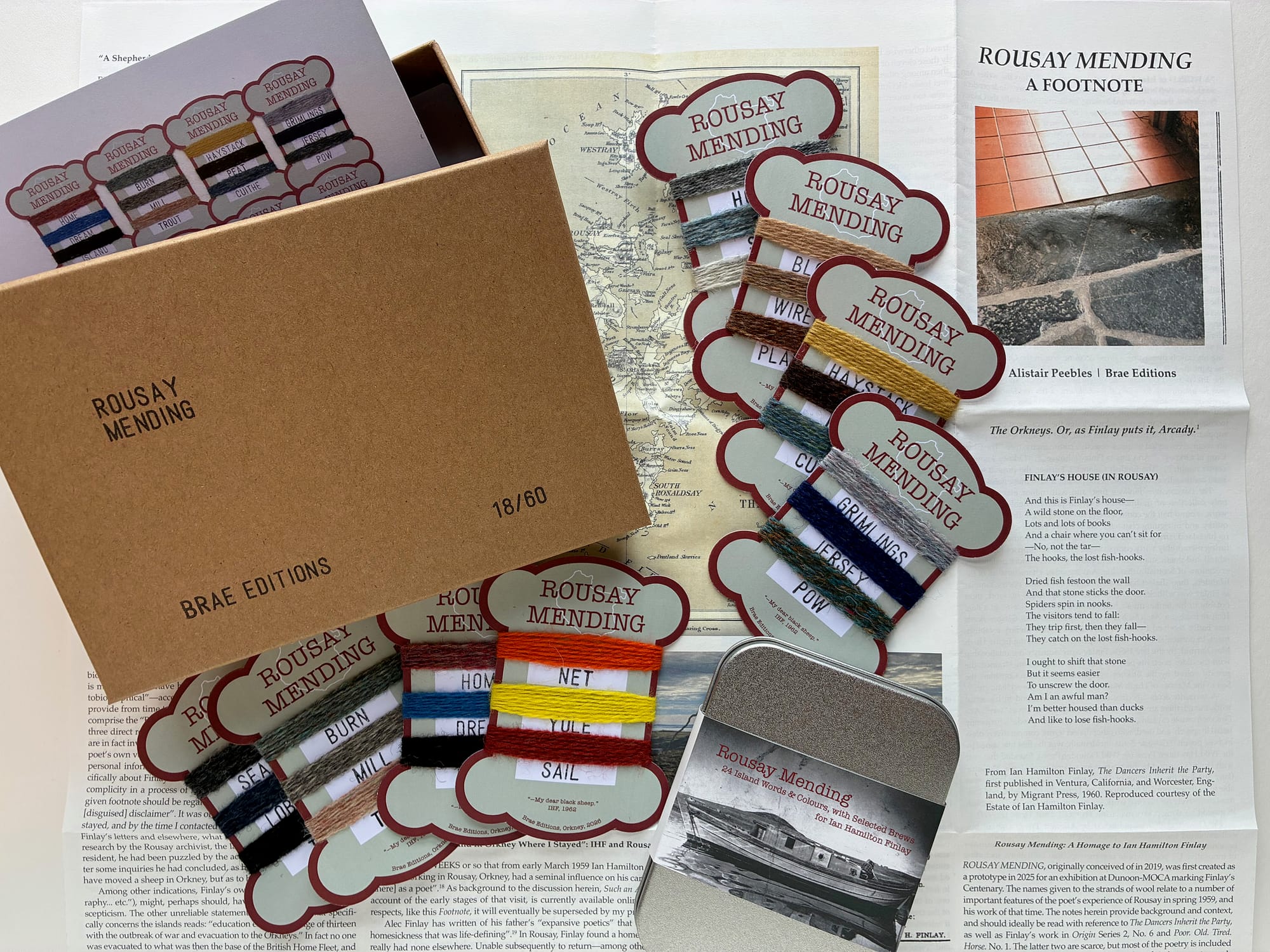
Rousay Mending is presented in a hinged metal container (110 x 80 x 25mm), with a band that carries the title, the author's signature and the colophon. It contains eight bespoke commercially-printed cards die-cut in a design derived from those traditionally used for lengths of wool as sold for darning and repairs. These are hand-stamped in each case with three words, and hand-wound with three corresponding (and thereby implicitly re-named) colours of Shetland 2-ply wool.
Thus there are 24 words and 24 colours in total, 3 of which represent teas, Finlay’s favourite beverage. Each word refers to an aspect of Finlay’s seminal residence in 1959 in the island of Rousay in Orkney, and/or to the poetry he wrote there or about there. (See below.) While together each set of words constitutes in effect a poem—e.g. “SEABOOT/LOBSTER/TAR”—taken as a whole they convey, in combination with the associated strand of wool, and the rest of the mending kit, the homage intended.
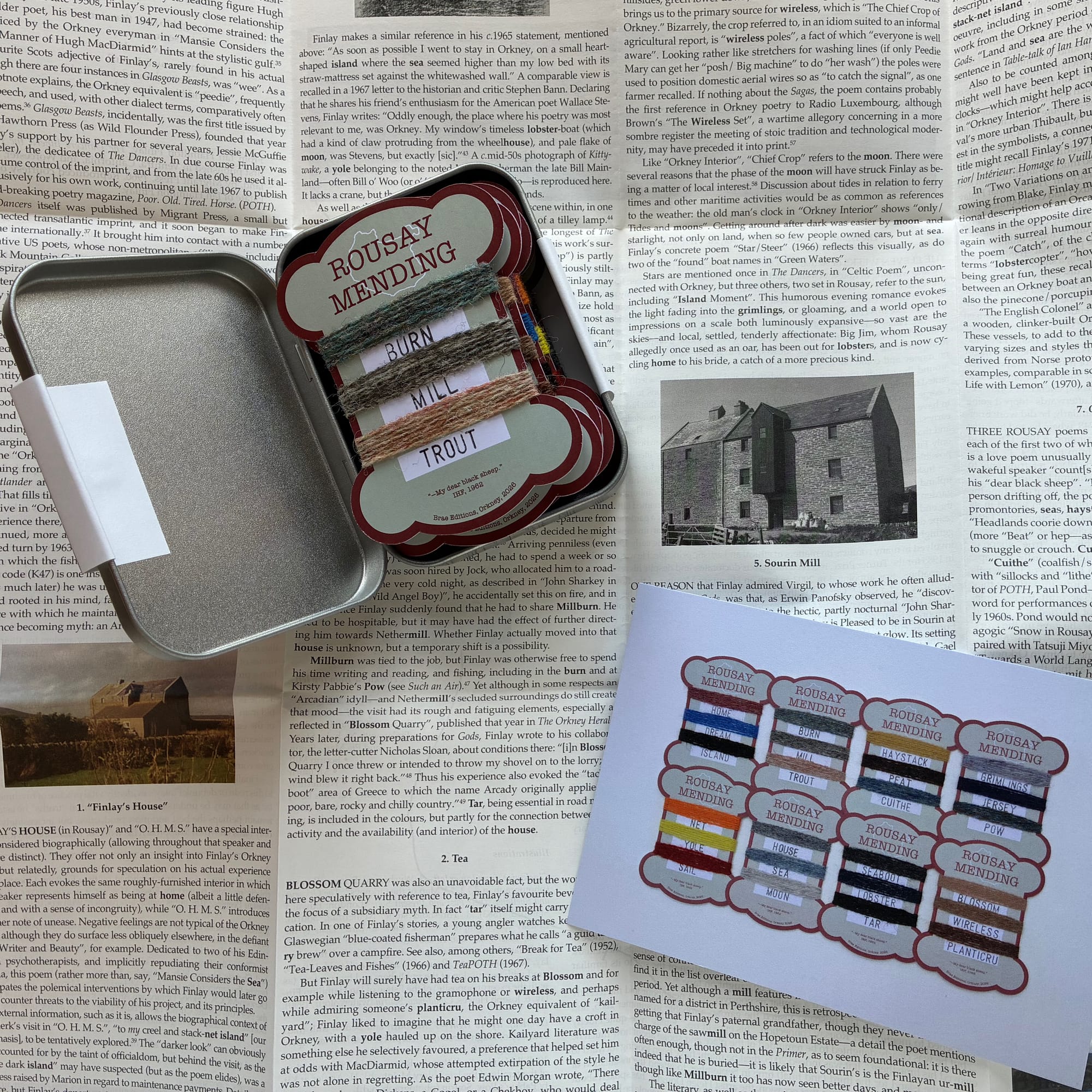
Rousay Mending—a Footnote comprises an A2 90gsm sheet, printed both sides and folded to A6: a design based on that of the noted London quarterly art periodical Picpus. With map and illustrations, it provides an 8,000+ word contextualisation of Rousay Mending. It examines both the mythic and the personal significance to Finlay of that time and place in his career, and expands in detail upon the biographical and poetic implications of the words that appear in the kit.
The kit and the footnote, with a postcard to illustrate the contents of the tin, which collectively comprise Rousay Mending, are packaged in a box measuring 165 x 116 x 35 mm.
Rousay Mending is published by Brae Editions in an edition signed and limited to 60 copies. As indicated, it is available, price £125 plus p&p, from the Pier Arts Centre, Stromness, Orkney (in person or online) and James Fergusson Books and Manuscripts, London.
Online elements
Further material related to Rousay Mending is available online:
The Bibliography and the Endnotes for Rousay Mending: A Footnote.
A speculative narrative, Such an Air, in six parts plus coda, which provides further (partly imaginary) biographical background.
Biographical background
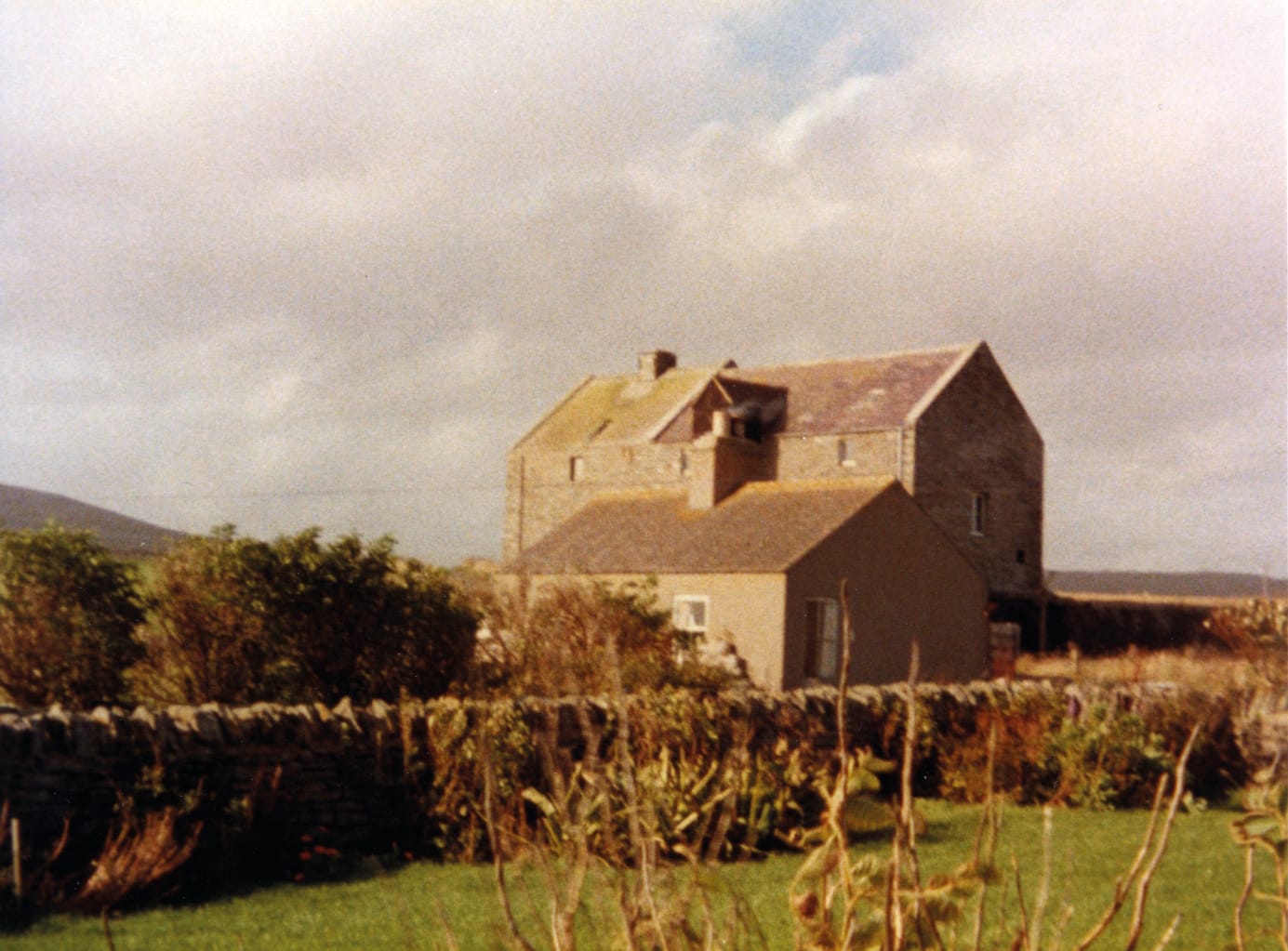
The second visit of around 12 weeks that Ian Hamilton Finlay made to Orkney in spring 1959, in particular to the island of Rousay, was pivotal in his early career. In the following decade, by the end of which he had begun to become internationally renowned also as artist and gardener/landscape designer, he would say that it was there that he became a poet.
Finlay supported himself at that time as a labourer with the island road squad, the visit occurring during a period not only of typically restless ambition but unusual levels of practical and emotional uncertainty. A few years earlier he had developed a nervous condition usually referred to as agoraphobia, and he was in the throes of an extended process of divorce. He was also chronically short of money.
The visit was in many ways recuperative, not least because this was precisely the kind of northerly maritime landscape in which he felt most at home. In addition, his residence also became the basis for an enduring personal and creative myth, partly established through the long-standing claim—obviously pertinent in the present context—that he had been a shepherd there after the War.
Originally realised in prototype last year as a centenary homage to a number of key elements in Finlay’s experience of the island, Rousay Mending was developed from an idea first considered in 2019. As well as his work on the roads, i.e. road building and mending, what it also, more importantly, reflects upon are the personally restorative effects of the visit, as well as his work of that time, and in due course the visit's seminal impact on his career. His near-habitual fisherman’s jumper is also in the frame of reference, something easily associated not only with his mythic identity, but that in photographs often looks in need of repair. As the typically minimalist and witty couplet "Ah, So That Is Why" informs the listener, fishermen wear "dark woolly jerseys" because they use them to "wipe their pens, my dear."
The Orcadian myth Finlay would go on to create comprised in part an alternative biography. For all the undoubted seriousness and ambition of his work, this creative invention even extended to the partly playful implication that it had been in Orkney, rather than in the ("inappropriate") Bahamas that he had actually been born. Essentially, and with qualifications, Finlay adhered to the principle that his biography (always scant) should not form part of the context of the reception and critical interpretation of his work. Such topics are discussed in detail, in many cases for the first time, in Rousay Mending—a Footnote.
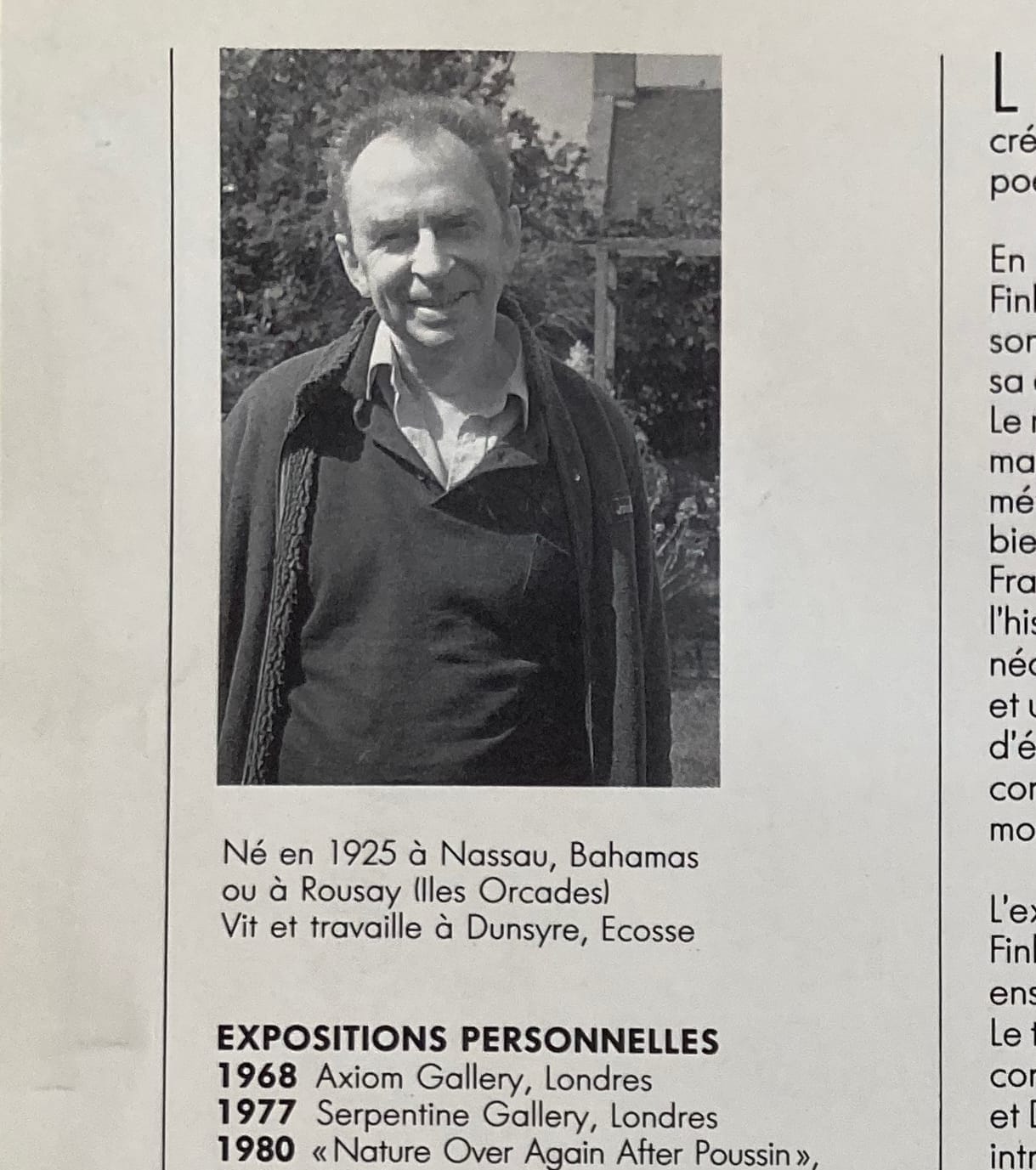
Rousay was Finlay's "dear black sheep", as he wrote in "Poet", a quatrain first published in Origin (Tokyo, 1962). "Most of the Orkney isles are low and green," Finlay recalled in a note to the poem, "but Rousay has beautiful hills, covered with heather, which is soot-black through much of the year—a soft black such as one finds in the paintings of Emil Nolde". That fond impression of the place remained with Finlay thereafter, although his third and final visit did not take place until 2005. It was then that he returned to supervise the installation of his magisterial landscape work, Gods of the Earth/ Gods of the Sea.
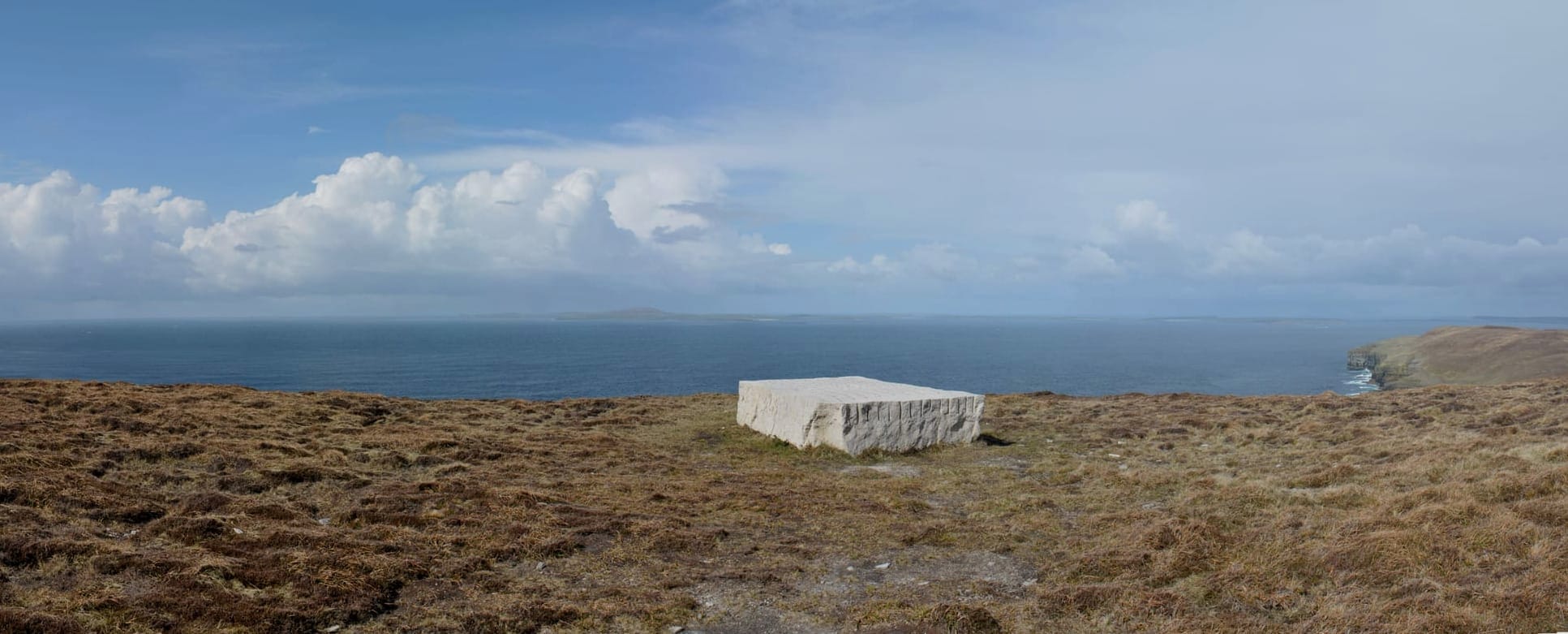
By that late stage much had changed in Finlay's work, and in his life, but the pastoral and maritime qualities of Orkney—a place which he referred to as "Arcady"—are unmistakably, if tacitly, evoked in the "inland garden" that is rightly regarded as his greatest achievement.
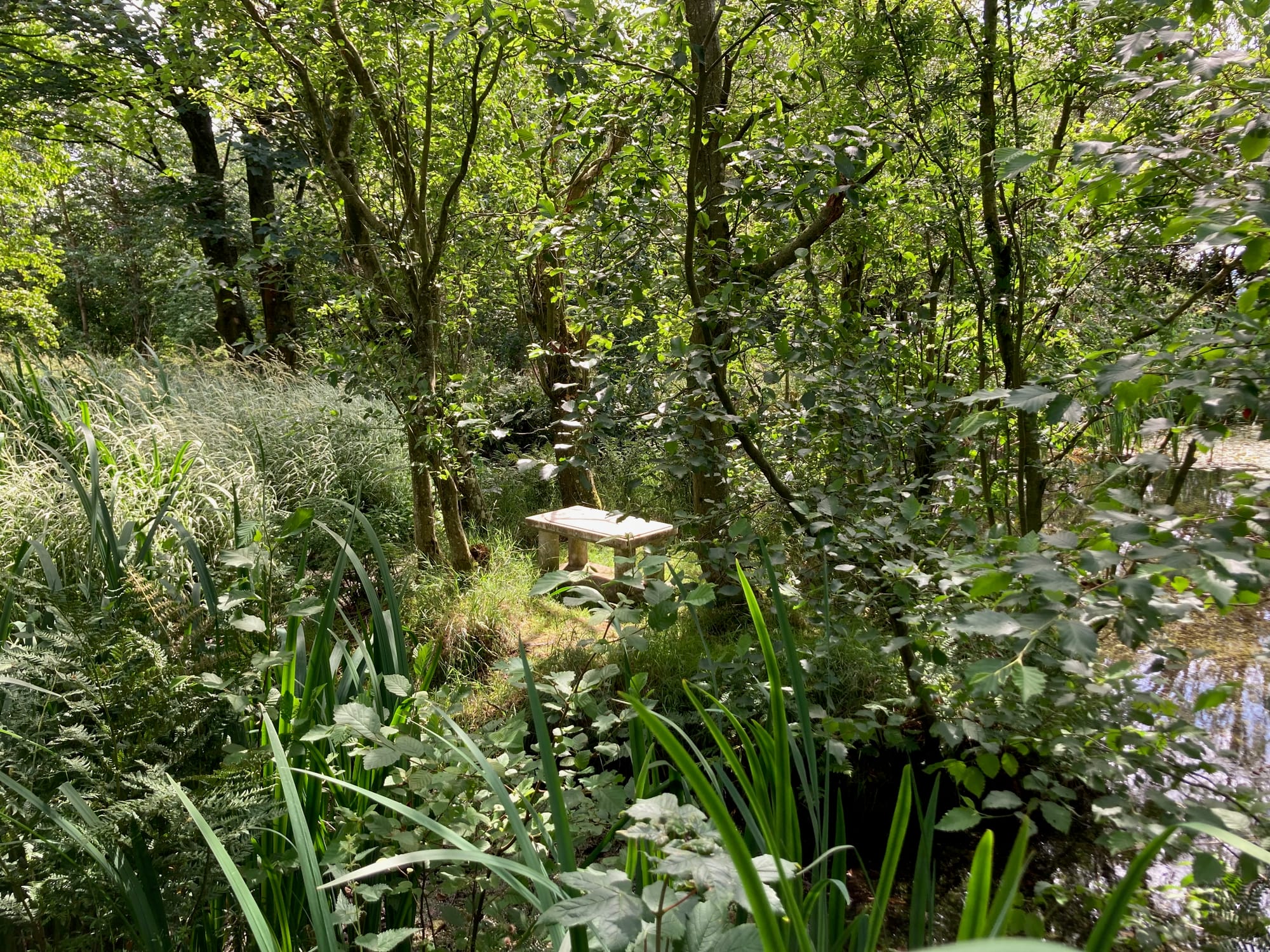
Created over a quarter of a century with his then partner, Sue, Stonypath, Little Sparta lies on a moorland hillside in Dunsyre, South Lanarkshire, 25 miles south-west of Edinburgh. A collaborative achievement made against numerous difficulties, meteorological as well as cultural, the poet's garden (not a sculpture park) is now widely regarded as Scotland's most significant contemporary work of art: a "spectacular example of garden design" as Magnus Linklater writes, the Chairman of the Little Sparta Trust.
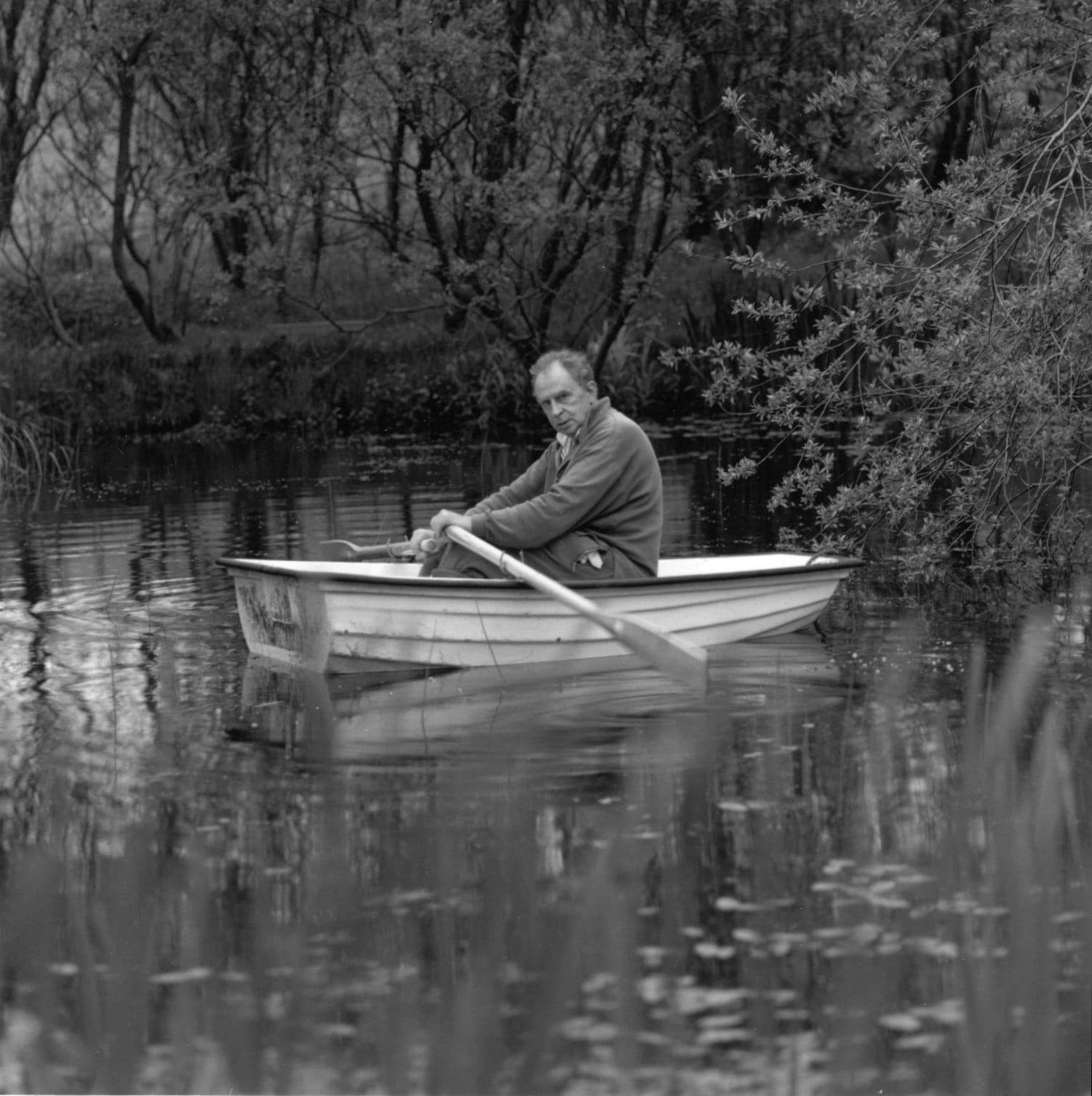
Had Finlay been able to stay in Rousay in 1959, or to return, he would undoubtedly soon have aspired to, and perhaps somehow acquired, a croft and a lobster boat. Resonances between Rousay and Stonypath, Little Sparta are evoked in the Footnote. Another poem expressive of Finlay's strong affiliation with Rousay, "O. H. M. S.", which with poignant irony carries an opaque indication of the reason he had to leave, refers to "my creel and stack-net island".
The poetry that Finlay wrote there and around that time, especially as published in 1960 in The Dancers Inherit the Party, first brought him international recognition. It thus opened up a new breadth of possibility, albeit always against the odds, including the opposition he faced from the Scottish literary establishment, something that presaged the many "polemological" conflicts (to cite Yves Abrioux) through which he strove both to establish and to defend the legitimate place of his exemplary moral and creative vision.
Alistair Peebles has long researched Finlay's life and work, especially of the pre-Stonypath period, i.e. up to 1966. He expects to complete work on a first early biography of the poet by 2028.