Such an Air (IV)
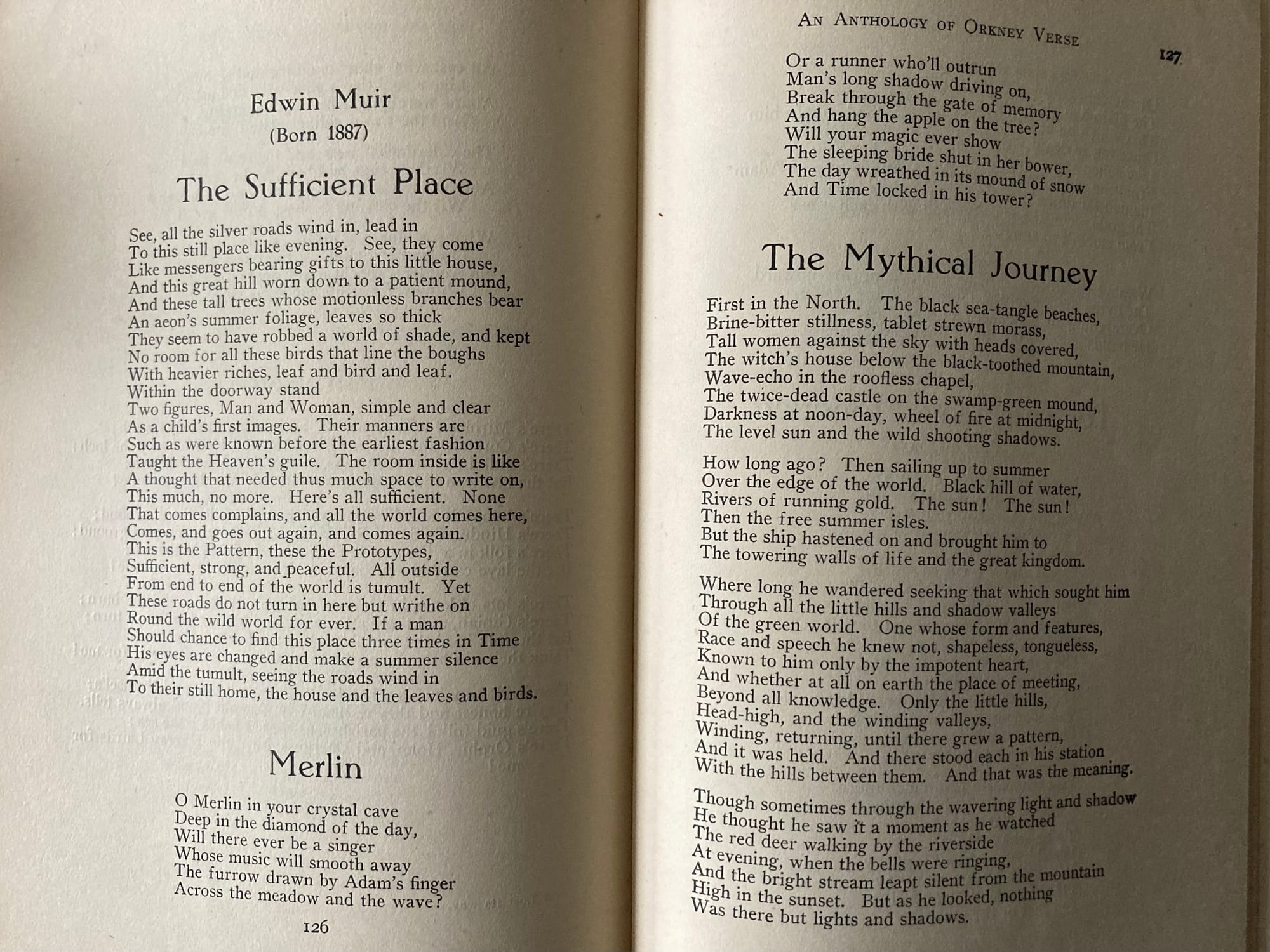
WEDNESDAYS IN Kirkwall were half-day closing, and the other week Ernest had asked Ian along to the Cathedral. He was keen to tell him more about the plans already in progress for a plaque to be installed there in Edwin's honour, interred as he had been in Cambridgeshire, at far-off Swaffham Prior. His friends the previous evening had discussed it all excitedly, an important new idea. Again they'd pledged support, promised contributions to any fund that might be established, discussed where in the Cathedral such a "poet's corner" might be situated.
Deserves something here, most certainly he does—where the fable first unfolded—many would agree—his family's going away was so tragic in its effects—though he travelled far—carried Orkney inside himself always—our own poets' corner: we celebrate, rightly, landowners, ministers, explorers, commend them to history and The Almighty. And support had come from south, you know, Ian, from Douglas Young and others.
Coats fastened, collars up, they made their way past the Grammar School, where Ernest greeted one or two among the staff, waiting in the steady drizzle for the returning scholars. He introduced the visitor and yes, was looking forward to meeting the Higher class soon to talk to them about Edwin, a former scholar there himself, on the tenth anniversary this year of his own Orkney Anthology.
And he would outline for their benefit the idea and significance of a plaque for Edwin at St Magnus. Word would get back to the parents too, you know? Any extra support would do no harm.
Well it was a fine idea, Ian supposed, whoever was in favour, though it grated with him. Where was the poetry in such civic entombment? Was this what it all amounted to? A name on a wall? Who decides? Though there was the Anthology. But so much private energy expended. Word would get back.
The "Dutiful" he'd pilloried in one of the new poems he'd brought, and "the social air"—Ernest had hemmed at that, and at much of the rest—or here the social stone or corporation brass. Bidding one uncover, as George had written prettily enough in his Gambit review. But how to find a space for the work itself, apart from all this obligation, still responsive to common suffering and the beautiful.
He listened patiently, however, admired for their own sake the carvings, tattered flags and stained glass emblems. There was suffering and beauty here too, no doubt. The walls, the voids and buttresses that evoked the originating sandstone cliffs, as Eric Linklater had observed in the guidebook.
A dozen years since they moved away to Ross-shire.
Ian hemmed at that himself but left the silence otherwise untroubled, though it had grown rather bustling around the choir.
But they quarrelled again over George’s St Magnus preoccupation, and his Catholic thing. Not that Ian minded any kind of faith on principle; but the rhetoric. Not at all, Ian. It may seem high-flown, but the subject lies precisely at the heart of the islands’ story, in the early context of a remarkable cultural flourishing. The poem both merits the elaboration and carries it magnificently… “Time’s bright harps … a riot through the acre of death” Such a rich and dramatic weave of heraldic figuration, all nature transformed, in the Christian tradition of Muir himself. I can't tell you the effect of the building on George when he first visited. Just look around you here, "the wonder and the glory of all the North".
So argued its dedicatee. Overloaded, thought the miniaturist. But it was its own interlacing skaldic world up here, and among the poets everything seemed to fall into place somehow, stone by stone, though not without neighbourly competition. (And as to how he could himself fit in, as if that was ever likely...) But there really was a spark in some work he'd seen, and George for all his odd proclivities had far more native talent than himself. Of course there were eccentrics and outsiders here, and wild fishermen's yarns, but it was much more integrated and unlike Perthshire largely classless. Everyone knew everyone... You could fit in perhaps, if that was what you wanted.
But again the Yeatsian stuff—For the islands I sing ... the hidden valley of light ... the countryside’s mirth ... Though The Storm's final section, as he'd read it over again, "Them at Isbister", with its rattling sneck, he liked. George said he thought the poem too much like Thrums—"Thrums at Isbister"—but Ian had a high tolerance for the Kailyard. (He should have brought some Crockett to while away the evening hours.) The moors, the dashing wee burns there and the limpid pools... He flexed his wrist, stretched his frame wearily, the skin stinging on his blistered palms.
Then he was following Ernest through a thick wooden door onto a flight of stairs, very narrow. Winding stairs, worn stone steps. Some obligation to fulfil. The door creaked shut behind them.
He felt faint suddenly in the gloom and reached for his friend's sleeve, who looked round kindly, Not far, and he relaxed a bit, took another step. Went on. Then they were in a loft where Ernest busied about with some mechanism or other. A weekly duty. The bell-ringer's chair loomed like something out of Belsen or Francis Bacon.
And then more stairs. This really wasn't... Were they going onto the roof? The quarry? The limbs of the building were the sedimented stones of time itself, uncovered,
A few more steps? Ernest clearly wanted to show him, if Ian could manage it.
The final door.
The heavenly stones.
The redeeming wave.
The spire.
The sneck.
The smirr.
Looking out, Ian felt himself trembling again. He reached sacrilegiously for a fag, but his pocket seemed empty. Couldn't swallow. Ernest was attentive, considerate, had had his own times. Had been away. A wee holiday, he called it. From the doorway they looked across the parapet, past the intricate roofs and streets, the returning scholars hymned in brass, hailing civic grace, to the shoreline and harbour, the boats, the grey sea beyond and the low, receding presences, more rain than material form. Monets stretching pole to pole. Far off too, the weekly practice starting up below. For the islands, singing.
Mary at his elbow, her perfume.
How were they—
He arose stiffly. Papers lay scattered.
Yawned, winced.
The sky in the window was nearly black. He lit the lamp.
Some tea. The primus stove. The kettle. It had been salt herring again at Lopness, and he was dry in the throat.
Notes
The above comprises the fourth section of a narrative in six parts, plus coda, which loosely concerns the early stages of the seminal second visit made to Orkney by the poet Ian H. Finlay (as he then was) in spring 1959. The title is taken from Finlay’s poem, from The Dancers Inherit the Party (1960), “Mansie Considers Peedie Mary”. It mainly provides background for a publication entitled Rousay Mending: A Footnote, the subject of which, naturally enough, is Rousay Mending, originally a centenary homage to IHF, also published in Orkney by Brae Editions, 2026 and illustrated below. See [link to follow].
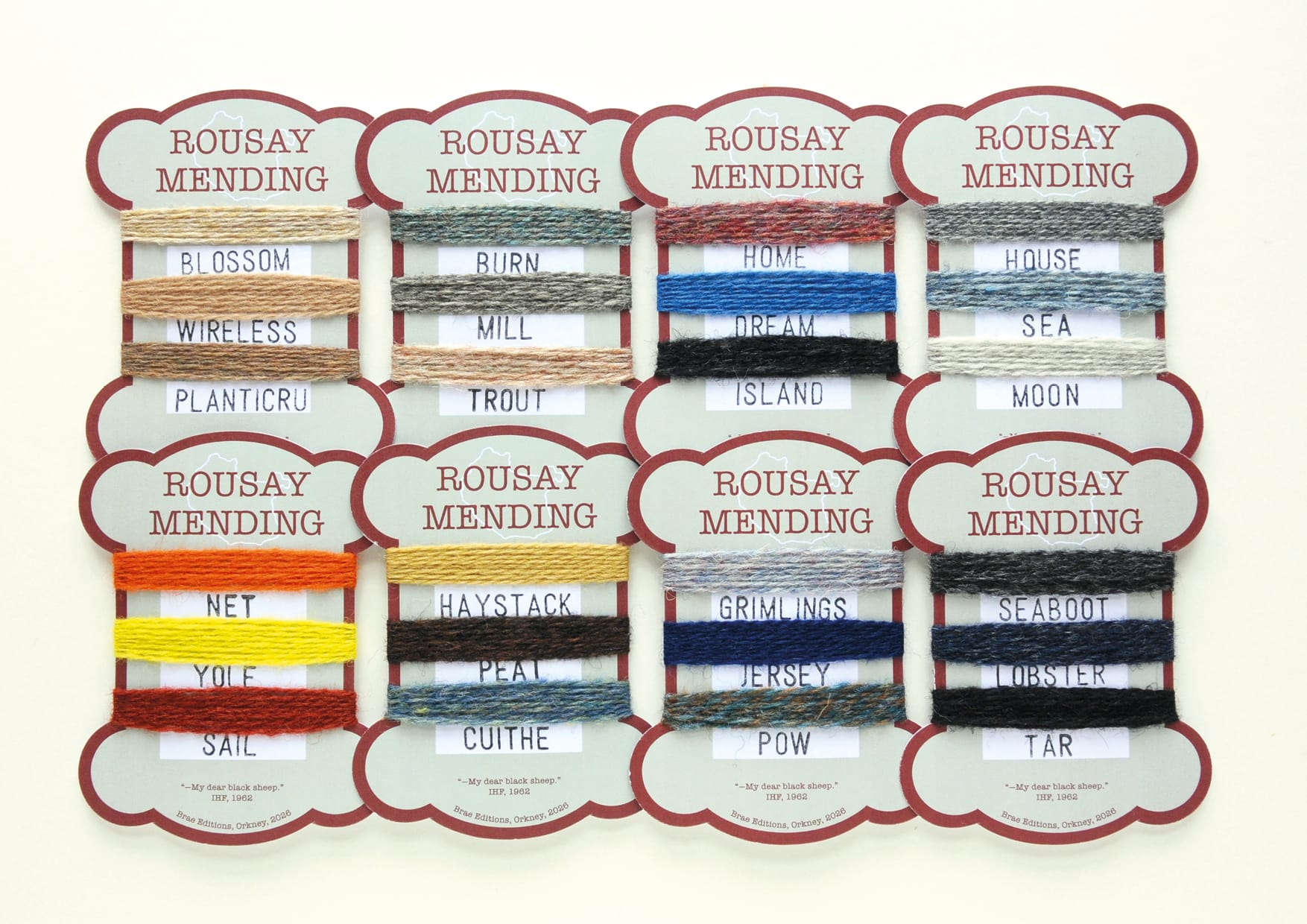
Such an Air is thus a speculative account of selected events, persons, and places that Finlay may have encountered in the early stages of that 1959 visit, the information having been derived from or been prompted by documentary sources, interviews and visits. The account borrows here and there from Finlay's work in ways which will largely be obvious, we hope, to his readers and admirers. But for the avoidance of doubt, we emphasise that a good deal of licence has been taken with what might have occurred during the period in question. Unlike Rousay Mending: A Footnote, Such an Air is not meant to be understood as factually accurate. It would hardly be true to say that no resemblance is intended to any person, alive or dead, but where it may be relevant to say so, no disrespect is intended to their memory. Further, no certainty is to be understood as having been assumed in representing how they thought about others, or how others may have thought about them.
The text above and those that follow will be revised from time to time and may be withdrawn without notice. There are no endnotes or bibliography, but reference may be made to those supplied for the Footnote, here.
Alistair Peebles, Brae Editions, Orkney, 2026