Such an Air (I)
“As soon as I could, I went to Orkney, where I started to write poetry.”
Ian Hamilton Finlay, c.1965
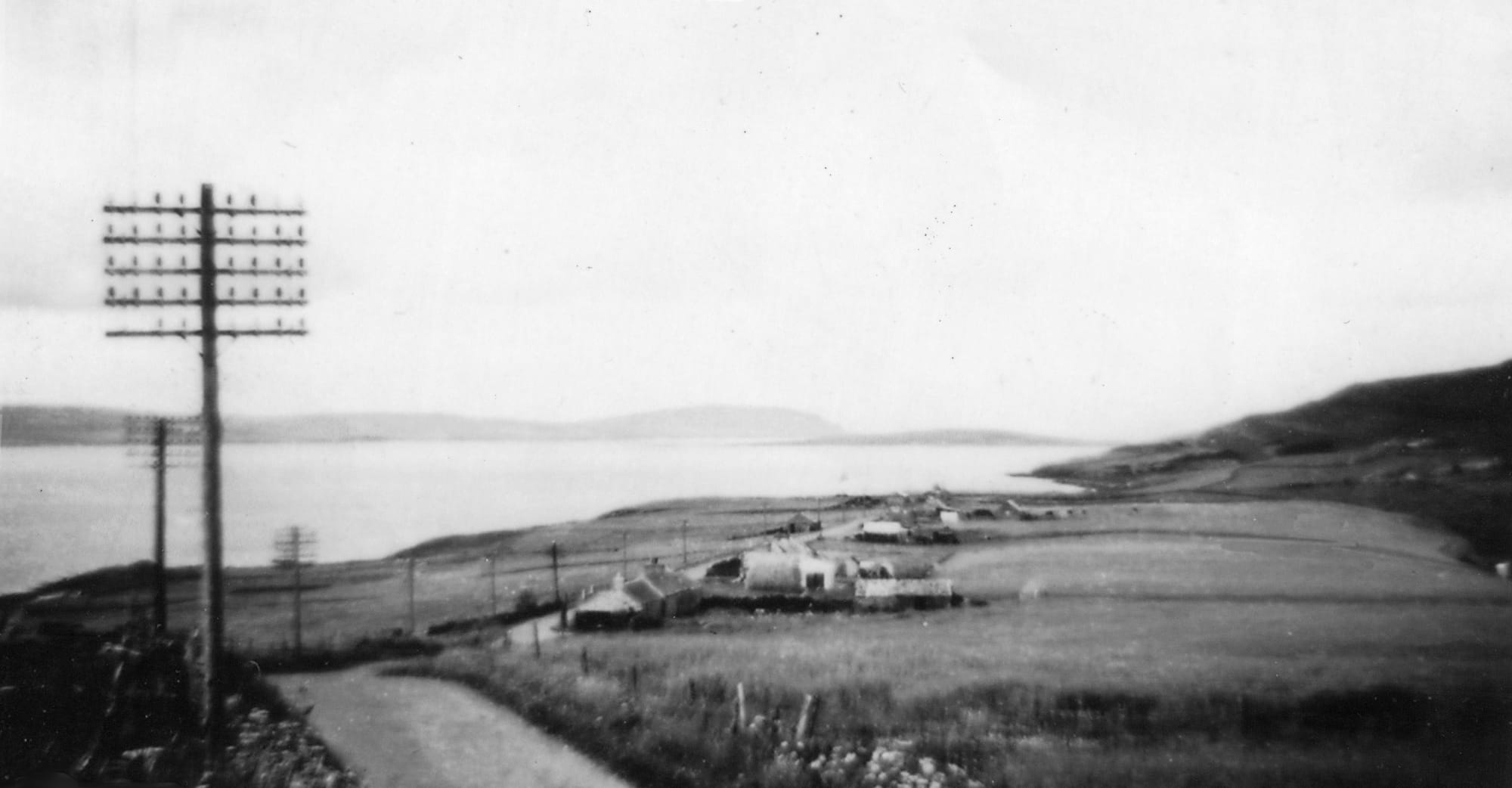
HE HAD DREAMED and spoken about it for months, for years. But at last, one evening in early March 1959, the 33-year-old writer and playwright Ian H. Finlay found himself on his way back north. His dear friend Mary had seen him onto the steamer at Leith, reassuring him in the taxi that yes, she'd visit as soon as he was settled.
Agoraphobic, prone to nervous exhaustion, and broke, more or less, the trip already postponed by a bout of flu, he'd found it almost impossible even to get this far. Without Mary's help, or someone’s, he could hardly have left his place in Rose Street. Yet he knew he’d be fine when he reached the islands, somewhere he’d long thought of as home, and where a home in the most practical sense was waiting. That the clinic could not understand this… Well, social integration on the terms they proposed was not for him.
He was met by a steward who helped him on board and saw to his luggage. The same old army kitbag he'd taken on his first visit, going up to join his now-estranged wife Marion. Since his return, and then hers, and the bitter aftermath, he’d hardly left the city, never on his own and never anything like as far.
That time, November ’55, he'd travelled by train, taking the P&O from Scrabster: impossible now, even with help to get him through it. But this time he was planning to stay, if he could. He’d also brought books and papers, some 78s, an HMV portable—there was no mains on the island—and his fishing gear. Bits of a manuscript, and a title, The Dancers Inherit the Party.
Izaak they cry me. An'ah answer tae it, bu' it’s Rab really; fae Rosyth, ken?
Rab saw Ian to his cabin, holding his thin, firm arm, vibrating gently through the rough fabric of his greatcoat. He told him he remembered his stories from the Angler—A pity that folded, eh? Ah've kept aw ma copies—and an article he'd read in The Daily Mail—Aboot a new book? Last year sometime?
The Sea-Bed and Other Stories, from Castle Wynd, was Ian's first, published in October. It had been years in the writing, up on their hillside in Perthshire. Rab remembered a couple of them gratifyingly well: the title story—some size'eh a cod! I mind that—and the one about the boy and the puir auld man. Ian would see about sending him a copy.
He'd been glad to get it out at last. Chris Grieve and the Milne's Bar crowd had ignored it of course, but George and Crombie and others were in favour. As indeed was The Mail.
Rab soon returned with cocoa and biscuits, and there was a pie if he wanted, that he could heat up? Ian, the “symbolist in tackety boots”—so he’d called himself in the Mail—smiled, wryly, and considered the shoes he’d just discarded, his only pair, wiggled the hole in his toe. Suede, city slicker. He’d worked last year in advertising, as the article had said. Rab laughed too when Ian told him about the Lawsons campaign, but he said he’d fetch it anyway—Cannae dae ony herm, eh?—though Ian, who’d hardly eaten all day, doubted he could manage much.
°°°
He felt the steamer cast off, and lay back, smoking, sleeplessly. Heard through the night the foghorns, each out-moaning the last. At Aberdeen he stayed put, picked at his breakfast, drifted off, and awoke to the lights around the Pentland Firth: Duncansby, Stroma, Cantick… Malin, Hebrides, Irish Sea… Mary, Gillian, Janet. Marion, out there on her own with a horse—his home too, as it used to be, his shed and the old table, the mountains and the pines. Sutherland the shepherd. The bitter, thrawn gamekeepers.
It had been a breeze coming up, though the sea had never troubled him, except philosophically, by its size. And by how a boat floats. “Going along lightly and containing its own air inside its dark hold", he’d put it once. A bit wordy.
In fact before he took the job at McCallum’s he'd been planning to sign up on a trawler, out of Granton or Aberdeen, till in Princes Street one day something happened inside him, a blurring and a tightening panic. He'd crumpled to the pavement and could hardly get back to his feet. Had to stagger along the wall, head averted, up to Edward’s. Humiliating, and absurd. That it came from nowhere made it all the more terrifying. Going along lightly indeed. Edward, concerned, had helped him back to Marchmont in the evening. He’d never been out on his own in daytime since, certainly not in the city.
ººº
Then he could see the islands, moonlit, reassuring. Mary came to mind again, dear Mary, and Gill—they would visit, he hoped, if he could manage to stay—and he thought again how it was all over with Janet. A new myth. She was married now, and maybe back in New York.
That was what had interested the Mail, of course. A chaos as usual; he’d held up the printer and changed the dedication. Asked one of the secretaries to oblige, though we’re not engaged or anything, she'd told the reporter. She has a boy friend ... Perhaps he should have dedicated it to his mother, as the reporter suggested. But at least the fact that he was married wasn’t mentioned. And it would have been unthinkable even for Marion to write in.
Suddenly the lights at Kirkwall appeared, and he could soon see the boats in the harbour, cheerful tethered ponies. His friend Ernest, a scholar, writer, and local cultural polymath, or one of them, was waiting by the pier. All would be well.
Serious and good-heartedly Orcadian, Ernest was vastly well-informed about the islands, though he came across a bit stiff: in both senses, Ian thought, this was really the result of his childhood illness. A severe back trouble that had prevented him from attending school. But for that he might have excelled not only within his own sphere, but on what he naturally regarded as a larger stage. Of course he was not alone here in thinking that way, despite the shared sense of pride in the place, but in Ernest it encouraged a bit too much self-doubt, carefulness. Being largely self-educated suited Ian’s restless and often prickly self-confidence, but it left his friend defensive.
Ernest was obviously still stricken about Edwin Muir, who'd died at the start of the year, and at first he could hardly mention him by name. Really. Aside from the esteem in which he held him as a poet, Muir had been his tutor at Newbattle, and he had latterly, he said, become someone he felt he could almost consider as a friend. Perhaps for those reasons, who knows, he didn’t seem inclined to say much about The Sea-Bed, although he’d seen the stories before, and had even turned down Ian’s approach about publishing them. Not that The Orkney Herald was likely to have been interested.
Yet Ian knew Ernest didn’t really approve of the work, though not quite why. His lack of qualifications? He'd left school in Glasgow still aged 13, and had barely attended the Art School, but what of that? Hadn't he had plays and stories broadcast on the BBC, and in Canada? Was it the gross informality of his beard? His footwear?
A “delicately ironic trifle” was how he'd described “National Assistance Money” when The Glasgow Herald reprinted it. Compared to Muir's work, no doubt, and to that of the Stromness wunderkind, it must be beyond the pale. But he wondered what Ernest might have thought of the Gambit review. Three of them, George had written, if not "The Money", were “among the best of Scottish short stories.” "Straw" came "pretty near to perfection". He'd identified a "radical innocence" in Ian's work, and an "innocent eye" that subverted the "Kafka nightmare" of modernity. Thus do "the walls of the labyrinth collapse". He'd asked George about that last month and yes, he'd also been thinking of Edwin.
But his name soon came up anyway—had Ian seen him? How was he? Not too much out and about? (Meaning the pubs.) He had to be careful of his health. And his book with Hogarth due in the early summer. They’d both read some of this in manuscript, Ernest probably most of it. It would be an event in Orkney, Ernest was sure.
Ian genuinely liked the pair of them—different as they all were—George in Edinburgh but still halfway in the islands—”Islandman” had been his pen name in Ernest’s paper—and this tweedy scholar, bookseller, journalist, thirled to the place. The others here too, that he'd meet again tomorrow.
And himself, looking for a new beginning, a home, a new myth, a known place.
Ernest and Janette put him up for a few nights until the weekly boat for Rousay, two hours in a south-westerly that finally did for his shoes.
Notes
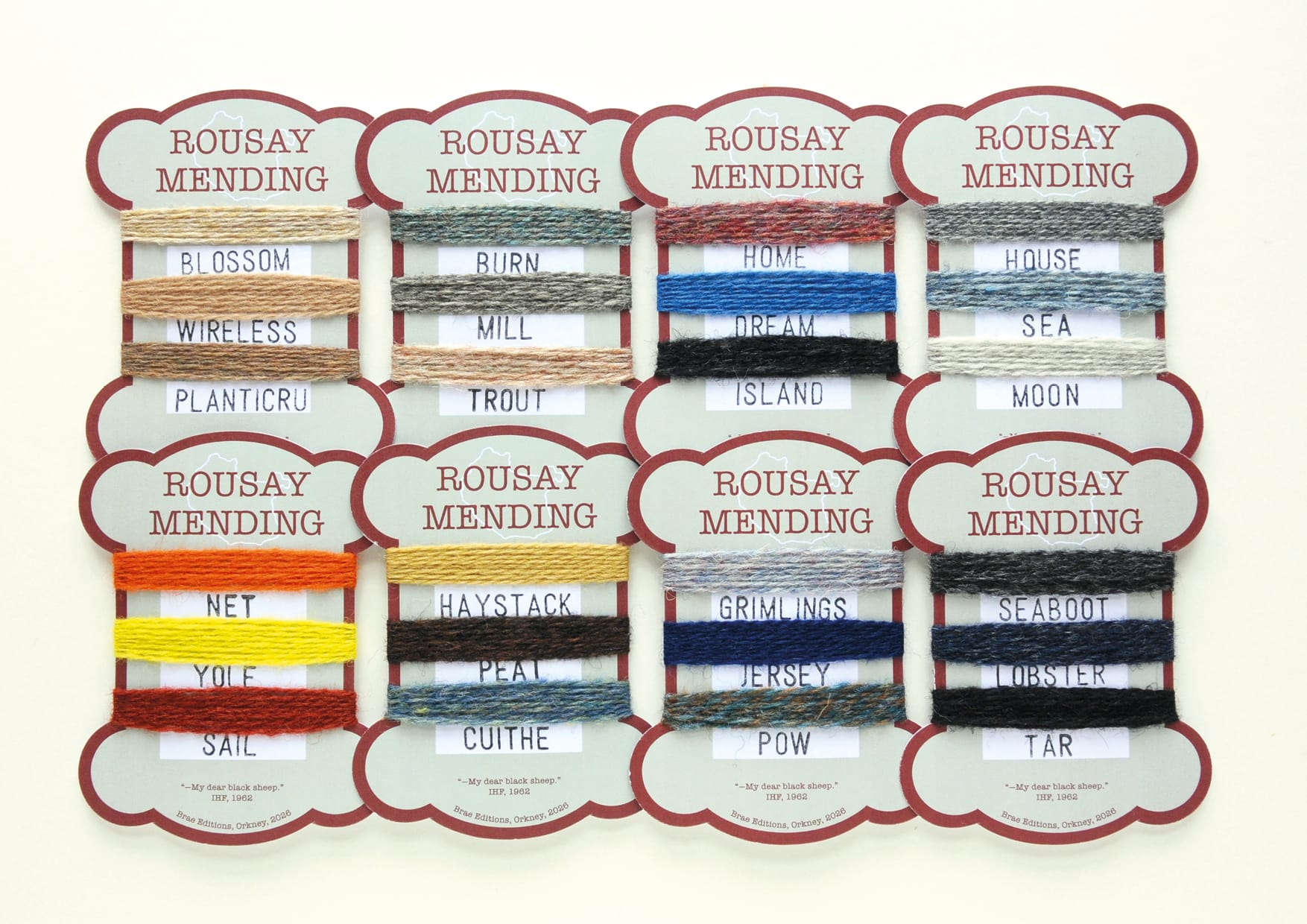
The above comprises the first section of a narrative in six parts, plus coda, which loosely concerns the early stages of the seminal second visit made to Orkney by the poet Ian H. Finlay (as he then was) in spring 1959. The title is taken from Finlay’s poem, from The Dancers Inherit the Party (1960), “Mansie Considers Peedie Mary”. It mainly provides background for a publication entitled Rousay Mending: A Footnote, the subject of which, naturally enough, is Rousay Mending, originally a centenary homage to IHF, also published in Orkney by Brae Editions, 2026 and illustrated below. See [link to follow].
Such an Air is thus a speculative account of selected events, persons, and places that Finlay may have encountered in the early stages of that 1959 visit, the information having been derived from or been prompted by documentary sources, interviews and visits. The account borrows here and there from Finlay's work in ways which will largely be obvious, we hope, to his readers and admirers. But for the avoidance of doubt, we emphasise that a good deal of licence has been taken with what might have occurred during the period in question. Unlike Rousay Mending: A Footnote, Such an Air is not meant to be understood as factually accurate. It would hardly be true to say that no resemblance is intended to any person, alive or dead, but where it may be relevant to say so, no disrespect is intended to their memory. Further, no certainty is to be understood as having been assumed in representing how they thought about others, or how others may have thought about them.
The text above and those that follow will be revised from time to time and may be withdrawn without notice. There are no endnotes or bibliography, but reference may be made to those supplied for the Footnote, here.
Alistair Peebles, Brae Editions, Orkney, 2026