Such an Air (III)
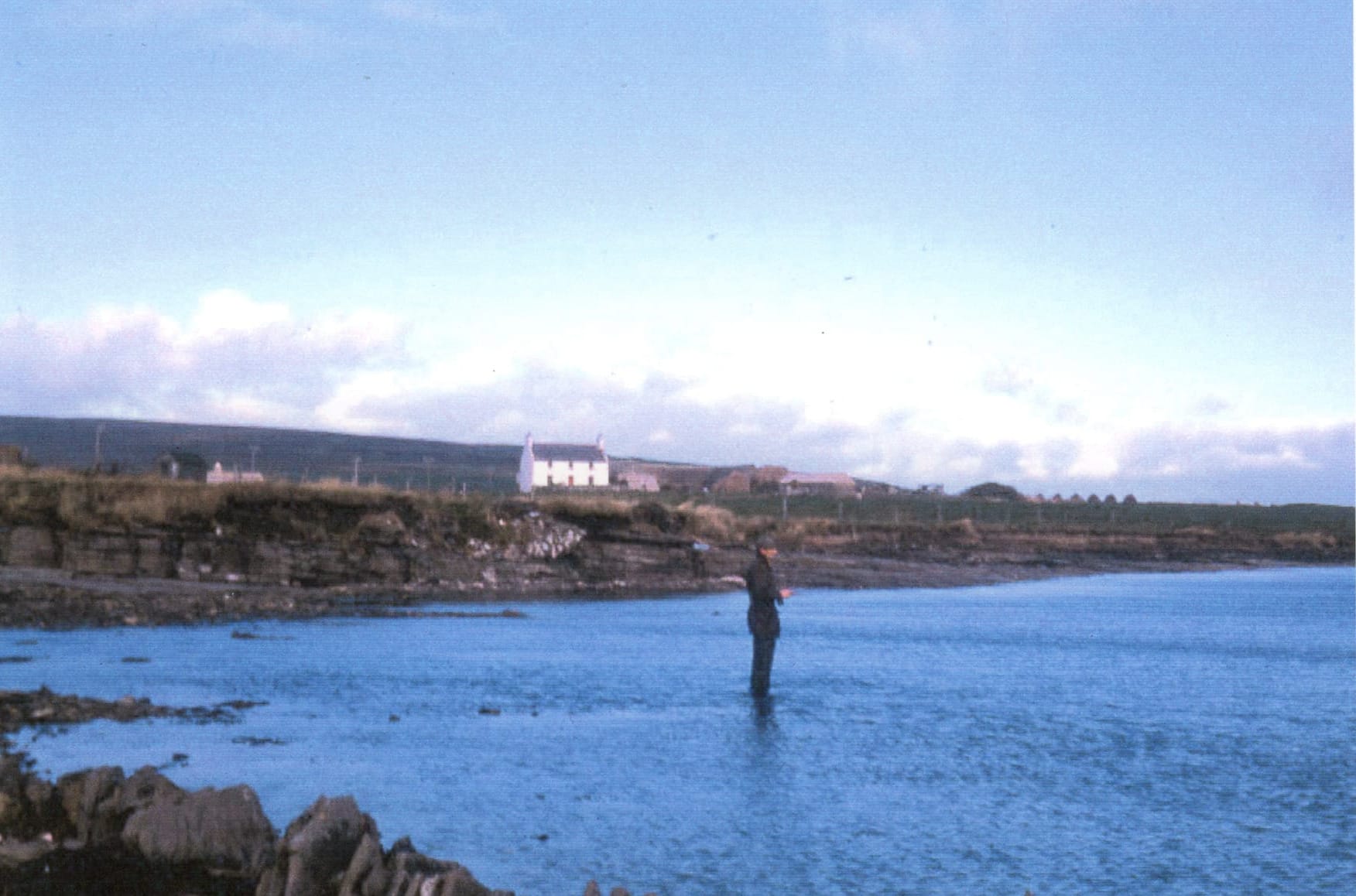
JOCK WAS out early to see to his creels, then fetched the lorry from the yard at the pier. The Shapinsay boys had taken care of yesterday's delivery, including extra road lamps—wee buggers, you find them everywhere, halfway up the cliffs—and a few bits and pieces for Millburn.
Glad to be out on a fine and breezy morning, Ian had slept well, written a couple of letters and managed a decent breakfast, porridge and quarryman’s tea, admiring the dinner that Jock had brought home, clattering in the sink. After a visit to Cilla's for boots, some hooks and a donkey jacket, all on account—she had everything from chandlery to sherbet dabs—they headed first to the quarry.
The surprise was all the greater from this side, the slow road going straight up Kearfea (black-domed, Nolde again), to a sudden, stunning view of the isles to the north and east, and out to the Atlantic, somewhat Friedrich, a world away from hemmed-in grey ravines like Rose Street. (Here, he thought, he was starting to sound like Islandman himself.) A gey an' windy hole, beuy, said Jock, as he braked for a wandering sheep.
No harbour over here, not till the Faroes, Iceland maybe, though ships of all kinds could be seen passing through, and creel boats below. Good fishing from the rocks yonder: Li Ber, Heshie Ber, Hun Ber round past the Knee. Slippy, mind. Dinna gae doon till'd wi ber knees, as they say.
Ernest had spoken about the origins of Ultima Thule, and Girlie last night said she'd read in an article he'd written that Agricola might have passed by, maybe even doon below the Blossan, imagine that. No that I ever go up there, I leave that tae Jock—till Jock, he'd say, coming from the Land of the Cat.
And we’re the Egypt of the North, Ian, she’d laughed, but with pride. The whisky Grants had owned Trumland in the 30s, digging up the mounds and finding ever so much. It brought in the visitors too.
A road lamp hung from the gate at Blossom Quarry, its flame guttering. A warning. Jock laughed, rolled his eyes.
A slumbering Moloch lay beyond. The stone crusher, wheels and jaws, exhaust pipes and belts; heaps of stone and tar barrels; any number of buckets and shovels and wheelbarrows. Ian's spirit was unrelieved even by the tea hut, fastened down with guy ropes, rocks and steel pegs, a wooden caravan tethered at the side. Another random road lamp dangled from the door. Still, he had another week to settle in.
He helped Jock unload, felt the salt breeze, the slight warmth in the sun, inhaled, stretched, hefted a shovel.
The view on the way back was breathtaking too, but different again, just as as the saying went. And a feeling arose in him, as they rolled on down into the valley, of the real possibility of settling here, of writing again—of painting again, eventually. A little surprised, he sensed a simple kind of homecoming might be possible, felt a kinship with the place itself as well as the abstract idea of it.
Jock stopped halfway to point out Millburn, down by the shore, and to show Ian the old peat road they were working on. From this height, the straits Muir had seen from his hill in Wyre were wide open, glittering in the sun. Ian wanted to allow himself a kind of optimism, of belonging, an innocent hope. He’d known that sort of feeling in Nassau, at his granny’s near Queensferry, and as an evacuee at Gartmore, with his first try at romance, and with Marion in their great early days at Dunira. With Janet too, and fleetingly, in the midst of everything, in fond moments with others.
On Egilsay, across the Sound, was the tower of the medieval St Magnus Church, home of George’s “praying sea [and] lyrical nests”. Along with his mother Mhairi Brown—they'd met her the last time—his other family in Stromness and his many friends, generations in the kirkyard, the Magnus story helped make Orkney George's spiritual or religious centre too. But his mingling of past and present was sound; it was everywhere here. Place names, ruins, tombs, faces. Personal names. Ian preferred “poor daft Sigurd” and Mansie, types he knew, but for George it was a great source and a solace. And he had his own Tir-nan-Og in "Rackwick’s compassionate hills” as he called them. Maybe they’d go there together, if George came home in the summer. A fisherman would take them across, on the FV Pathetic Fallacy.
At the foot of the hill, they turned off towards the mill, where Jock had wrought as a smith off and on. Three storeys high, it was one of the tallest buildings on the island, closed down recently but still intact and handsome. Jock described to Ian how the headrace was still open, but ran just in a dribble now more or less from the sluice at Woo. The water came all the way from Muckle Water, the loch at the top of the hill. A youngster from the valley would have the job of tramping up there to open the dam on milling days, before he went to the school.
A little further along, below a stone bridge, the burn flowed on down to the sea. It was full of trout, and never ran dry. The mill for years had served the whole island, and in a dry spring farmers had come from as far away as Westray.
Millburn stood directly across. Empty too since Rene got married, it had been built cheaply as a sub-post office ten years or so back. Beyond a peedie porch it comprised two small rooms with a chimney between, a fireplace to either side. There was a well nearby. It was sparely furnished, with a jug and basin and a home-made necessary. Ian could tell that given time, Jock would have seen to improving it. Anything of Rene’s had been removed. Anything of Ian’s was still in Comrie, and rent due.
As well as a bed and some of Ian’s bits and pieces, Jock had brought along an old chair, a Primus stove and a saucepan. It would hardly be snug, but there was plenty of fuel. Jock and Girlie had provided him with woollen socks and ankle-length drawers.
He had known a lot worse—an old kennels once in a desperate time at Balquhidder—and could surely make something of this.
Across the burn was Lopness, the one house nearby still occupied, where they’d arranged for him to get his meals and his laundry done, and the post office was there now too. The Co-op shop was no distance away. Jock and Girlie had teased him last night about finding him a space in Wychwood with the Shapinsay boys, but he’d already turned down any idea of lodging.
Below Millburn on this side of the burn stood Nethermill, right on the shore, much older, actually two small buildings close together, stone-built like the mill, but rougher. Both were unoccupied, Jock said; the owner lived over on the Mainland. It pleased Ian that along with Millburn it occupied a small sort of island of its own, between the burn and the tailrace, which carried just enough flow to count. It felt defined, enclosed. And peaceful. His own world, more or less. With the burn-sound and the Lopness ducks for company.
And there was fishing. When it reached Nethermill, the burn was forced through a channel quarried from the bedrock, and where it hit the shingle, along with the tide, the force had helped create a large pool. Like a small sea loch it seemed to Ian. Kitty Pabbie’s Pow, some said it was called, well-known for sea trout, and flounders.
One of the Nethermill buildings was used occasionally as a fishing bothy, but few would likely come there while Millburn was occupied. It sometimes flooded in a high spring tide, but it was dry enough inside, with whitewashed walls.
Ian lifted the door over the clumsy slab and stooped to its tiny window. The sea filled most of the view, almost like a porthole. Billo’s Kittywake was lying at anchor, carrying what carried it. The air inside its hull. Some kind of paradox, and yet there it was and here I am and completely itself, like a poem or a piece of art. Or like someone just getting on with things. With panache.
He hadn’t lived near a burn since Perthshire, and never so close to one, nor to the sea. You could hardly be any closer to it except in Stromness, in a house on one of the piers. He'd have liked that. Behind the Kittywake was the Holm of Scockness, and beyond it lay Egilsay, all linked by tidal races you could hear from inside. Mair panache.
Perfect.
Notes
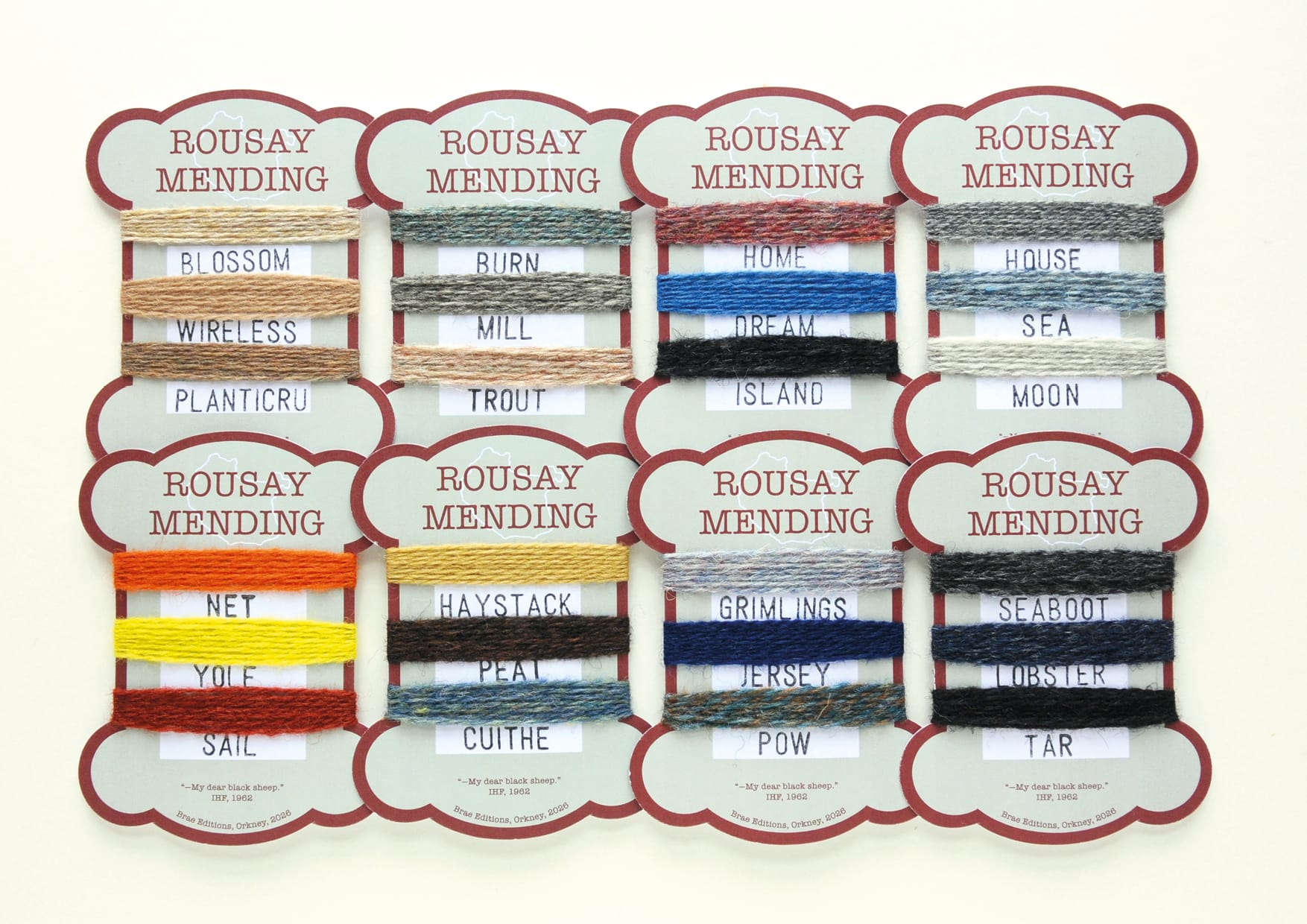
The above comprises the third section of a narrative in six parts, plus coda, which loosely concerns the early stages of the seminal second visit made to Orkney by the poet Ian H. Finlay (as he then was) in spring 1959. The title is taken from Finlay’s poem, from The Dancers Inherit the Party (1960), “Mansie Considers Peedie Mary”. It mainly provides background for a publication entitled Rousay Mending: A Footnote, the subject of which, naturally enough, is Rousay Mending, originally a centenary homage to IHF, also published in Orkney by Brae Editions, 2026 and illustrated below. See [link to follow].
Such an Air is thus a speculative account of selected events, persons, and places that Finlay may have encountered in the early stages of that 1959 visit, the information having been derived from or been prompted by documentary sources, interviews and visits. The account borrows here and there from Finlay's work in ways which will largely be obvious, we hope, to his readers and admirers. But for the avoidance of doubt, we emphasise that a good deal of licence has been taken with what might have occurred during the period in question. Unlike Rousay Mending: A Footnote, Such an Air is not meant to be understood as factually accurate. It would hardly be true to say that no resemblance is intended to any person, alive or dead, but where it may be relevant to say so, no disrespect is intended to their memory. Further, no certainty is to be understood as having been assumed in representing how they thought about others, or how others may have thought about them.
The text above and those that follow will be revised from time to time and may be withdrawn without notice. There are no endnotes or bibliography, but reference may be made to those to be supplied for the Footnote, available here.
Alistair Peebles, Brae Editions, Orkney, 2026