Such an Air (II)
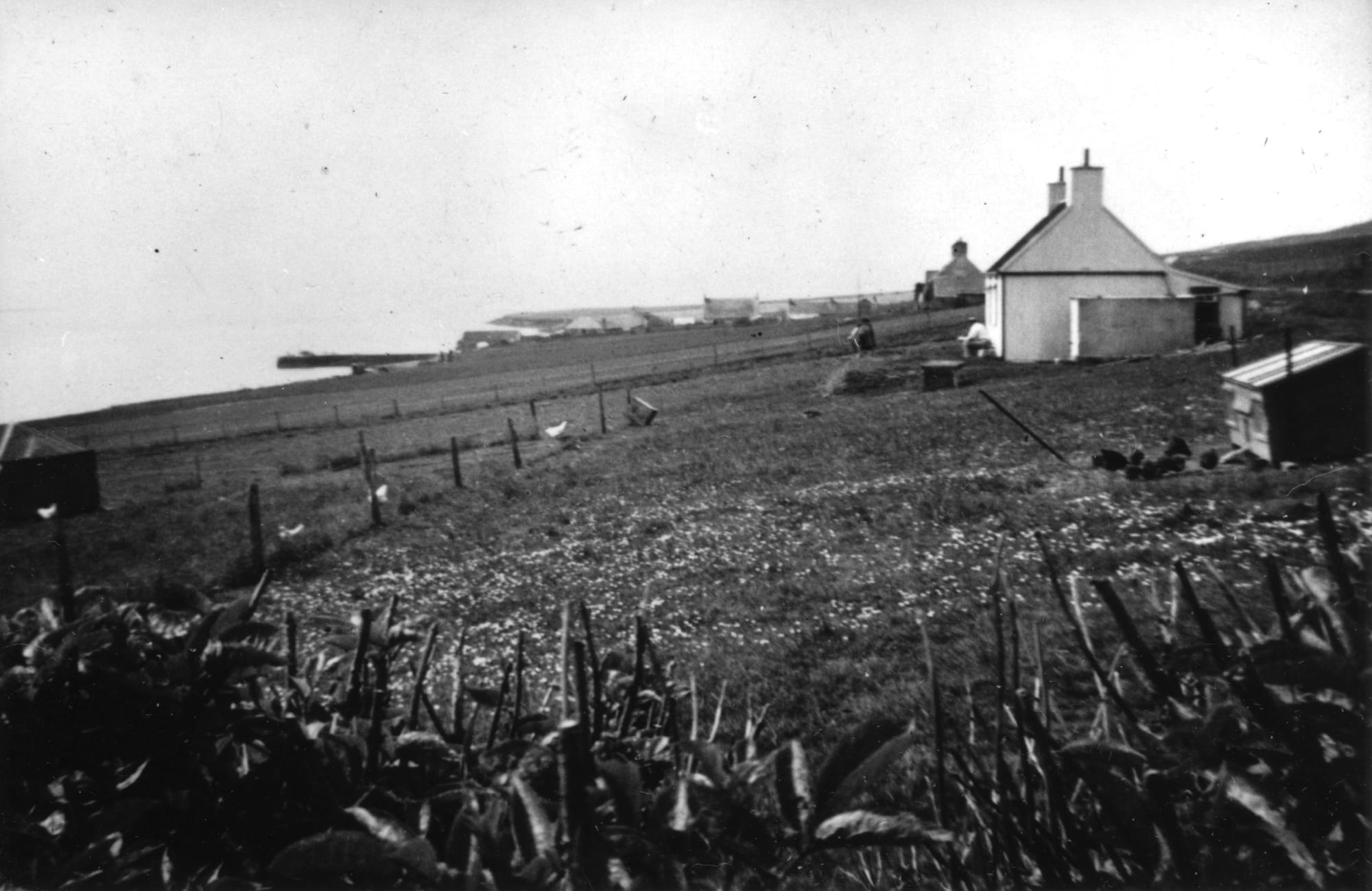
THE SEA AIR, the sea spray, the unbearable cabin, the long hill of the island coming closer and closer, rearranging levels, shapes, becoming itself. Sooty-black hilltops that so resembled Nolde's painting in the book Janet gave him that Christmas. All as though summoned from the Rousay place in his heart, like the other smaller landmarks he began to make out. Trumland, the big house, bright in the sun; the tidy wee—peedie—cottages and their patches of fields; the pier and its signature crane. And suddenly too, and bustling, its signature crowd, in their seaboots, jerseys and overalls, swarthy, well-set. Tractors lined up like a toy shop window.
Big Jim, "Steebly", an oar of a man, ducking out of the door of his mother's shop. He had a barrow there, loaded with lobsters and partans, ready to be swapped for the new stores just arriving. Behind him appeared Cilla with a few more instructions. A force he remembered. He spotted Girlie, over at Daisy Cottage, out below the scudding clouds and among the hens and ballooning bedsheets, a genre scene, waving a tea towel in welcome, just as when he’d left. Touched, he waved in return, the wind blowing sparks from his fag end.
Jock was with them too on the pier, and the Shapinsay road boys, swarthy and shining, ready for one last job before they headed off for the weekend. One or two other faces, stances he recalled. They’d all know he was coming, and so would the folk now around him on the deck, but after his few days in Kirkwall he felt ready enough.
His luggage was swung ashore, someone passing him down by hand his rod and tackle, and all was loaded into Jock's “iron horse”. Home-made, two wheels with an engine and trailer. Up the hill they went. As easy as that.
ººº
And there stood Girlie out at the road now, corralling the hens, as they puttered along past Wychwood, her guest house. Marion had taken it for the winter that first time, Ian following after. He’d left early too, a month or more before she did, one morning when the islands were sparkling, snow-covered; his mind as numb, more or less, as the rest of him. It hadn’t helped mend anything, and his writing was already stuck. No ideas had come to him here.
She'd spent the fine, short days drawing, painting, walking, while much of it he was inside, depleted and displaced, trying to read. Neither had been here before, and she not since, though she knew how to pull his strings from afar. Keep him dangling. Everyone would remember: Wychwood was only wooden, after all, and no distance from Daisy Cottage and Veira View. Calm nights under the Merry Dancers, thundering rows within.
Girlie had named the house after the novel by John Buchan, but with a fancier spelling. Born just along the road, she’d lived here all her life. She loved her trinkets and laughter, her books and any gossip, community concerts, was famous for her baking. But shrewd with it, and witty. She gave him a wee hug. A peedie hug. She was glad to see him. All smiles. He’d explained things often enough in his letters, and no one said anything. It had worried him, but it was all a worry.
Jock too was cheerful, bantering and friendly. They’d said in letters they'd be glad to put him up till Millburn was ready, a few miles away in Sourin. They had no children—either, he shuddered—though relatives of all ages came calling, cousins and endless neighbours. They jist loved haen visitors, and their spare room had a comfy double bed. They were both around fifty: still in their prime, as Aunt Tot might have said, who'd often looked after him in her posh St Andrews flat.
What she would make of all this—or his mother—besides Och, it’s just Ian... But his father would like it here, who’d chosen the Bahamas and then thrown everything into farming or whatever it had been in Florida. A wee croft would have suited him better, and he’d surely prefer Rousay to West Partick. They never spoke about it, at all. Not that he saw them much these days or wrote terribly often, but kept in touch, and he had happy memories of that earliest island life, the schooners, the sponge boats, the grand airy houses, Highland Nana, and even the hurricane, its amazing aftermath.
Far away...
Unreal? Maybe. No connection with his life now, certainly, hopeless as that was, at least until he could get writing again, and fishing. Some human warmth. A place. A peedie yole. But the memory was real enough. The times out fishing with his parents, the boats and the wharves; endless horizons, islands; Nana reading to them in her soft voice, or crooning, telling stories, taking them for walks; his mother letting him play with her paints, encouraging him; kicking a ball with his father, choosing his cigar for him, winding his watch, helping with the football pools.
The view from here—his world now, or the world he wanted—was just as he remembered it. The painted fixtures in the Sound, fishing boats and creel boats, and the pier still swarming around the steamer. MacLeod the doctor's new black car being craned off. A sensation. Thankfully there was someone to talk to, who could perhaps help him cope, though he already felt more like himself, more than he had for, what? For nearly three years.
Across the Sound lay Wyre. Muir’s island, as Ernest could be forgiven for having reminded him. And that beyond it “the massed islands rolled in mist away”. Perfect in expressing the child’s perspective, both familiar and reassuring—with his parents at the farm below—and beyond, the “unseen straits”. A special poignancy in the present circumstances.
He'd told Ian one day of how he'd taken Muir, on what would be his final visit, up from England somewhere, to meet after fifty years a boy who’d grown up with him on Wyre. And then how overwhelmed he'd been by a view one evening, asking, Where would you find words to express that? And, Where could you go in all the world to find anything as beautiful?
It was his valediction, Ian.
They were all in mourning. Last month in Edinburgh, George had described him as the greatest Orkneyman of the century.
Muir had gone with his family from here to the city, a “stupidly wretched” move, where Ian’s own parents too had wound up, but carrying all this with him, as they with them had carried their own broken Eden. The post-War transit camp near Sennelager came into his mind. His own transitory life, his need for a centre and for definition, on his own terms. The difficulties and misunderstandings that had always assailed him.
He watched as the steamer fired up her engines again, blew her whistle. It pleased him, a sound he remembered from the Clyde. When they were here before like Muir he too had responded to all this, visually, but the place itself had interested him much less, and he’d been appalled when the social circus started up at Hogmanay. Home-brew and whisky, tractors like wayward slow-motion Keystone Cops going from house to house. Round and round. Too much.
But the tranquillity that had wearied him overall was what almost immediately made him long to return, when his own disaster struck. He could have stayed on in Stromness, harder-edged than here, among the piers and the fishermen, had they been able to find a place, an attic even, or a hut. But failing that he’d needed his Perthshire myth, till Marion finally pulled it all apart.
ººº
Jock, a blacksmith and quarryman, was from Wick. An outsider too, therefore, a ferrylouper—but a character, well-enough respected, and resourceful. As well as his iron horse, and a diesel-powered electrical supply to both cottages, he’d brought their water from a spring by the shore, drilling through solid rock, and built a pump house that served both too. But mainly he worked (or “wrought” as in “rout”) as foreman of the island road squad, drilling, setting the wet dynamite at Blossom Quarry.
There was plenty of work this year, with a mile or so of peat track to be metalled and tarred. Girlie was putting up the Shapinsay boys in Wychwood, and in a week or so Ian was to join them and the rest of the squad up at Blossom—to start with, anyway. Like the peat track, the quarry was over on the other side, at the highest point of the circular road. “Go round one way,” they said, “and if you get tired of it, go round the other.”
He and Marion had once circuited the island, clockwise, now and then with help from a passing farmer. In the right mood, she was a pleasure to be with. Och, that’s terrible, he’d say, and she’d reply, Just terrible. It was a weary ascent, but with tremendous views, and he remembered the place, and the curious name.
Girlie had Marwick’s Place Names on her bookshelf, which Ernest had looked up for him a day or two before: “The Blossan: ‘the blown or windy moor’”. It was there beside her copy of The Sea-Bed, and she at least didn't mind speaking about it. Was it himself in the stories? And in yon Broken Engagement?"
What a sad turnabout, she said, and a right peedie scamp. He came off nicer in the others.
He agreed, pleased that she’d read them. Sat down with an appetite, to take his tea.
Notes
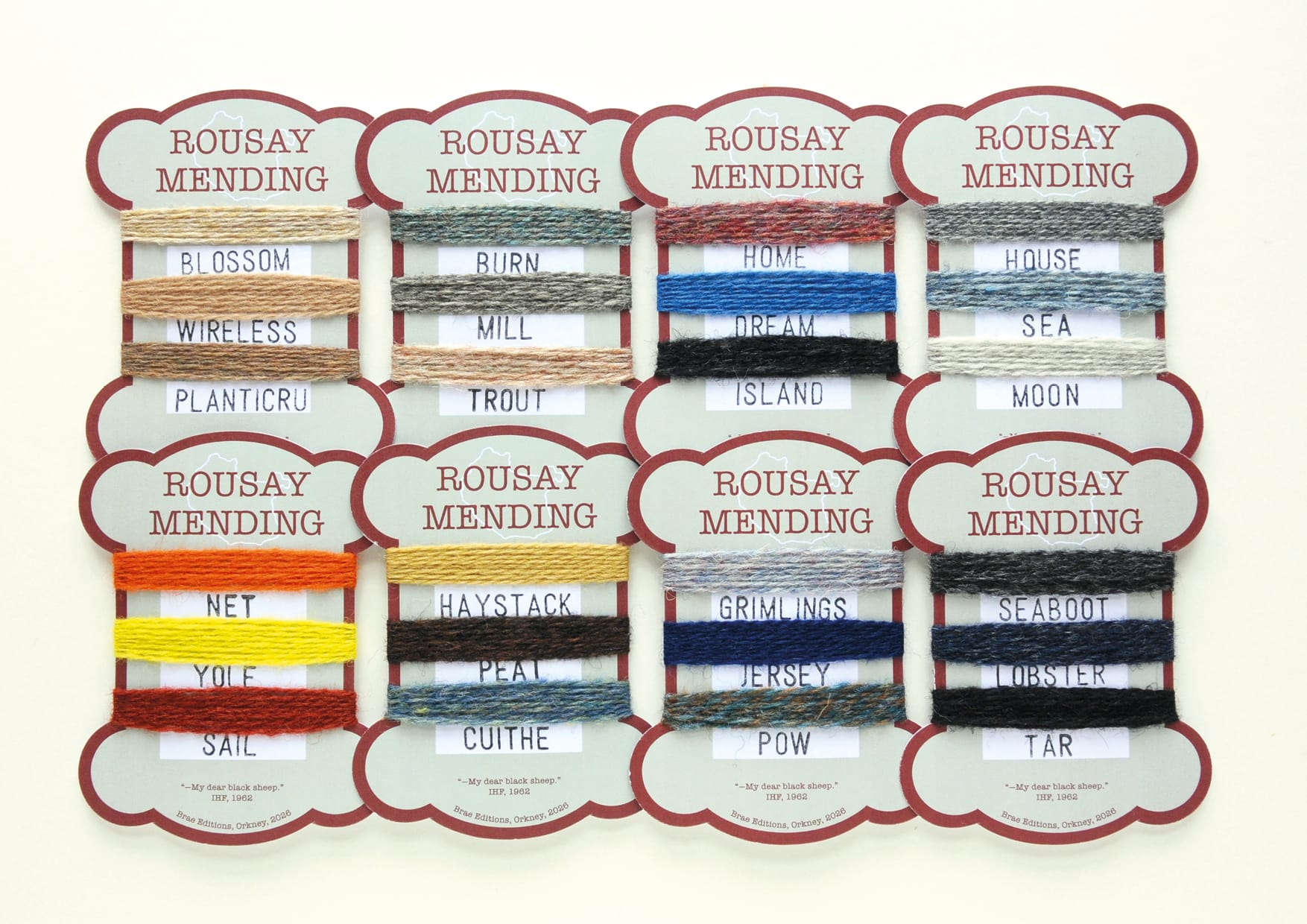
The above comprises the second section of a narrative in six parts, plus coda, which loosely concerns the early stages of the seminal second visit made to Orkney by the poet Ian H. Finlay (as he then was) in spring 1959. The title is taken from Finlay’s poem, from The Dancers Inherit the Party (1960), “Mansie Considers Peedie Mary”. It mainly provides background for a publication entitled Rousay Mending: A Footnote, the subject of which, naturally enough, is Rousay Mending, originally a centenary homage to IHF, also published in Orkney by Brae Editions, 2026 and illustrated below. See [link to follow].
Such an Air is thus a speculative account of selected events, persons, and places that Finlay may have encountered in the early stages of that 1959 visit, the information having been derived from or been prompted by documentary sources, interviews and visits. The account borrows here and there from Finlay's work in ways which will largely be obvious, we hope, to his readers and admirers. But for the avoidance of doubt, we emphasise that a good deal of licence has been taken with what might have occurred during the period in question. Unlike Rousay Mending: A Footnote, Such an Air is not meant to be understood as factually accurate. It would hardly be true to say that no resemblance is intended to any person, alive or dead, but where it may be relevant to say so, no disrespect is intended to their memory. Further, no certainty is to be understood as having been assumed in representing how they thought about others, or how others may have thought about them.
The text above and those that follow will be revised from time to time and may be withdrawn without notice. There are no endnotes or bibliography, but reference may be made to those supplied for the Footnote, here.
Alistair Peebles, Brae Editions, Orkney, 2026